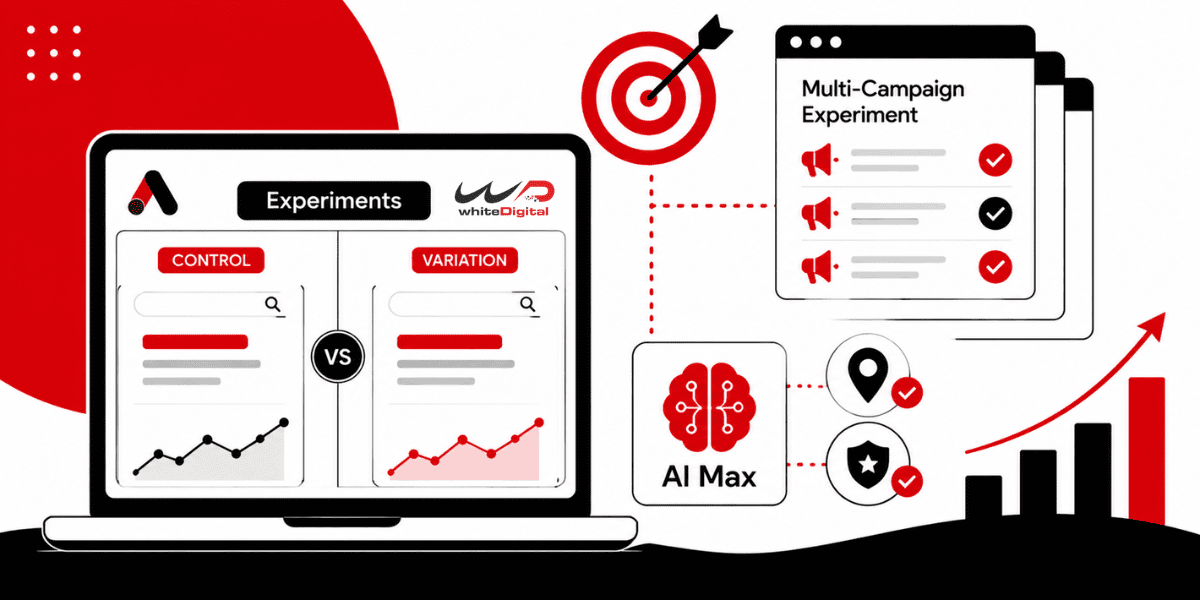
Google Ads has added more features that give advertisers the ability to test any changes to their campaigns prior to implementing those changes in their entire account. New features have been launched that make experimentation in Search campaigns and AI Max more flexible.
It becomes especially relevant because Google is moving toward automation in Search advertising. Marketers become more dependent on automated bidding, AI-based matching and various features of AI Max, which requires more flexibility when testing.
Now it is not necessary to make a change to the campaign and evaluate its success later. The marketer can test changes and see how they perform against a control and then decide based on the results.
An essential feature is multi-campaign experimentation. In September 2026, it will be possible to test budget and ROI target changes for several campaigns in one A/B test. It will allow you to test campaigns in a situation where performance is determined by a few campaigns, not a single one.
Google also extended experiments in AI Max by letting marketers maintain brand and location controls while experimenting.
Together, these updates strengthen Google’s experimentation framework and give advertisers a more structured way to evaluate automated campaign changes before committing larger budgets or account-wide strategies.
Multi-Campaign Search Experimentation Is Coming
The most notable development is the capability for Multi-Campaign Search experimentation that will be rolled out starting in September 2026 by Google. In the past, advertisers had to test changes individually per campaign or use some other testing setup. Now it becomes possible to use multi-campaign Search experiments.
It’s important because a lot of advertisers have accounts where different campaigns cooperate. A company may have various campaigns for different products, geography, services or segments of the customers, but budget and ROI goals are managed at a larger account level. Testing changes individually may be inefficient in assessing overall impact.
Multi-campaign experiments help to test changes like increased budgets or ROI targets over a set of Search campaigns in comparison to the control group. This means that advertisers will have the possibility to evaluate whether budget scaling or different efficiency targets result in better performance.
For example, a marketer who thinks about making a budget increase can test the change in advance. An agency can assess whether a particular ROI goal works well in the context of several campaigns.
The feature should make strategic testing more representative of real account management, particularly for advertisers managing portfolios of Search campaigns with shared performance objectives and significant budgets.
AI Max Experiments Offer More Control
Additionally, Google is improving experiment functionality for AI Max for Search campaigns.
This is necessary since the controls associated with campaigns are known to influence the performance of the campaigns. Controls such as brand impact what types of branded searches qualify, while location influences where the campaigns are to operate. Simply removing controls from the campaigns only to experiment with AI Max could lead to misleading results.
AI Max experiments allow for testing Google’s AI-driven Search features prior to implementing them on campaigns. According to the current documentation, features being tested by the AI Max experiments include search term matching and asset optimization. Rather than creating a campaign copy, the experiment partitions the traffic in the campaign to trial and control experiences.
Google claims this method offers faster results and fewer setup errors, along with reduced learning time since all traffic would still be within the same campaign.
Change of Campaign Settings via Performance Planner Gets Easier
Another improvement introduced by Google in the Performance Planner is related to making campaign modifications easier. The Performance Planner will be able to tell advertisers what effect their changes will have on their campaigns and offer the possibility to implement selected suggestions.
Traditionally, planning and modification of a campaign were two different actions. An advertiser could use Performance Planner to consider some scenarios and then go back to campaign settings to make the necessary modifications. Now, with the new workflow, the process will be easier, as the eligible changes can be implemented in one click.
It is important to remember that it is possible to consider modifications at the campaign level and decide not to select those campaigns that need to be changed. The marketer is thus able to look into the suggestion provided by Performance Planner and does not have to take it as an automatic instruction.
The changes made by the advertiser are traceable via Bulk Actions in Google Ads. Google also offers the possibility to revert changes if it is needed. This update allows Performance Planner to become more practical for advertisers dealing with budget and bidding targets in multiple campaigns.
Forecasts are estimates, not guarantees. Advertisers should consider seasonality, conversion volume, business constraints, and recent performance before implementing significant budget or bidding changes.
Why Improved Testing is Important for Automated Advertising
These updates come at a very relevant moment since Google Ads continues to become more automated. Smart Bidding determines auction-level bids, AI Max allows identifying opportunities within Search campaigns, and automation plays an increasing role in creative and targeting choices.
When manual controls are reduced, experiments are among the most valuable instruments that advertisers have to maintain strategic discipline.
The Experiments tool available today includes different types of experiments – Search, AI Max, Performance Max, Demand Gen, video experiments, among others. According to Google, one should define a hypothesis and measure the results in terms of business objectives.
The new features are not just more buttons in Google Ads. They solve the problem of how to test machine learning-based changes in campaigns.
Better experimentation can help advertisers identify incremental improvements, avoid unnecessary changes, and make larger account decisions using evidence rather than short-term performance fluctuations.
Taking the Next Steps for Advertisers
The introduction of this new strategy means that advertisers can incorporate testing and experimentation into the management of their Google Ads campaigns. Not only can they alter their budget, bids or implementation strategy, but they can also formulate a hypothesis, implement the suggested experiment, and evaluate whether it should or should not be used on a larger scale. Coming to an end, these new tools give marketers more opportunities to test intelligently, measure incremental impact, and scale successful strategies with greater confidence.