
Advertising on Google is not simply about improving your own ad performance. Advertisers need to understand how other advertisers with similar audiences are doing, as well. Although your ads convert and bring you leads, it is always possible that your competitors may be getting impressions worth your money and have more visibility when it comes to searches.
That is why auction insight reports come in handy. The report shows you the performance of your ads compared to competing ads and how often your ads show up for the same audiences as other advertisers.
However, you should remember that auction insights will not reveal all the details about your competitors. The report does not include information about competitors’ budgets, targeting options, bidding strategies, and other reasons that can help them win the auction.
What Is Google Ads Auction Insights?
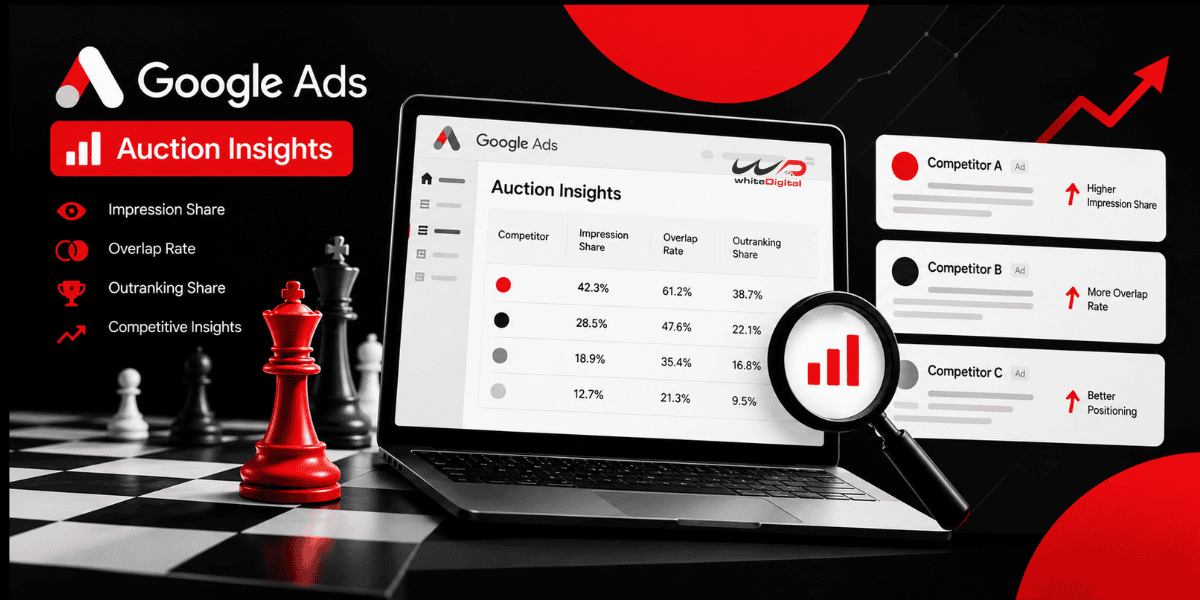
The Google Ads Auction Insights report is a comparative analysis of your advertisements performance against other advertisers involved in the same auction processes. The report is available for Search campaigns, Shopping campaigns, and Performance Max reporting, each having a different set of metrics.
For search campaigns, the metrics include impressions share, overlap share, outranking share, position above share, top of page share, and absolute top of page share. All of these metrics provide information regarding your visibility and competitive positioning.
For instance, if a competitor’s impression share goes up and yours goes down, this could be an indication of change in the competitive environment. In case the competitor keeps appearing along with your advertisement and outranking it, then you may need to look into your bid, ad relevance, landing page experience, or budgets.
The most important point is that the auction insights tell you what is happening in the auction but not why it is happening. Advertisers will have to compare these metrics against their own data to come up with changes.
Key Google Ads Auction Insights Metrics Explained
- Impression Share
Impression share means the proportion of eligible impressions that have been shown in your ads. It is calculated by the number of impressions divided by the estimated number of impressions your ads could achieve.
In the example of ads receiving 6,000 impressions and having 10,000 impression opportunities, the impression share would be 60%, and it means that your ad was shown every opportunity it had according to eligibility conditions.
In auction insights, you can see the impression share of your competitor during the auction represented in your report. A competitor with a high impression share could appear even more often to gain these impression opportunities, but it could not mean having a bigger budget or visibility in general.
It is necessary to examine the reasons for having a low impression share, since it may not always mean the need to raise the bids. Use your search lost impression share data to verify whether the budget or ad rank is an obstacle for your visibility.
- Overlap Rate
The overlap rate is a statistic that tells you how many times a competitor’s advertisement got an impression when you had an impression. It allows you to determine which advertisers are frequently competing with you.
For example, if any advertiser’s overlap rate is 60%, in six out of ten cases when your advertisement has shown up, the advertisement of that advertiser has appeared as well.
Thus, a high overlap rate suggests that the advertiser often appears next to your advertisement. It is a good sign to find the direct auction competitors if your company competes with many brands by keywords or any other parameters.
However, the overlap rate doesn’t allow concluding if any competitor is indeed winning the auctions, as the success of a competitor might be different.
In order to succeed, identify competitors who constantly have a high overlap rate in important campaigns. After that, check their presence, taking into account devices, time periods, as well as keywords they use. Then, watch for any visible changes in your position or performance along with your competitive presence.
- Outranking Share
Outranking share measures how often your ad ranked higher than another advertiser’s ad, or your ad appeared when theirs did not, relative to the relevant auctions in which your ad was eligible to compete.
For example, an outranking share of 40% against a competitor means your ad outranked that advertiser or appeared when its ad did not in 40% of the relevant opportunities covered by the metric.
In general, a higher outranking share occurs when the advertiser manages to outperform the competitor more often when using this particular metric. A lower outranking share could be evidence of champions bidding on your brand name or absorbing precious opportunities when competitor ads are seen but yours are not.
Be careful in interpreting the metric. A low outranking share doesn’t directly imply your bids are not high enough. A good outranking share may be obscured due to lower ad rank, budget constraints, eligibility for some ads, or limited participation in the auction process.
Rely on the outranking share along with impression share and above rate because another advertiser might appear often on your behalf when you see the outranking share of yours is low. If your campaigns succeed and are generating conversions already, it may be reasonable to consider other factors before allocating budgets for competing positions.
How to Use Auction Insights for Campaign Optimization
The best way to use Google Ads auction insights is to connect competitive signals with actual campaign performance.
You have to start by identifying the campaigns that have low impression share or rising cost per conversion. Almost in each industry, businesses would prefer to dominate their respective markets. The main reason is rather simple. The market leader is usually the one with the largest share of customers, which will always make it the most profitable entity.
Therefore, answering the following questions will help to sustain the leading position. Is the competitor’s impression share improving? Or… Has its presence in the advertising market increased? If yes, the business has to identify reasons for such improvement.
In order to achieve this, it is not enough to only compare the market performances of the competitors. It is also essential to check whether the budget assigned to the campaign and its bidding strategy have changed. It is also important to remember that changes in the search volume can also alter the results.
Moreover, it is not enough to identify what bids would bring optimal results during the campaign. It is necessary to select the most important auctions using the analysis of auction insights.
Coming to an end, Advertisers can leverage Google Ads auction insights to see competitive positions in the ads auction, even without access to competitors accounts. The impression share shows how often ads are shown in relation to their available opportunities, while the overlap rate indicates how often advertisers appear together. The outranking share indicates how one ad performs versus other competing ads in the auction.
Combined together, all these metrics can indicate the growing competitive environment or the missed opportunity of the campaign. The goal is not to outrank every competitor.
We should focus on the use of the obtained competitive information in order to make better decisions about bidding, budgeting, and the importance of ads.