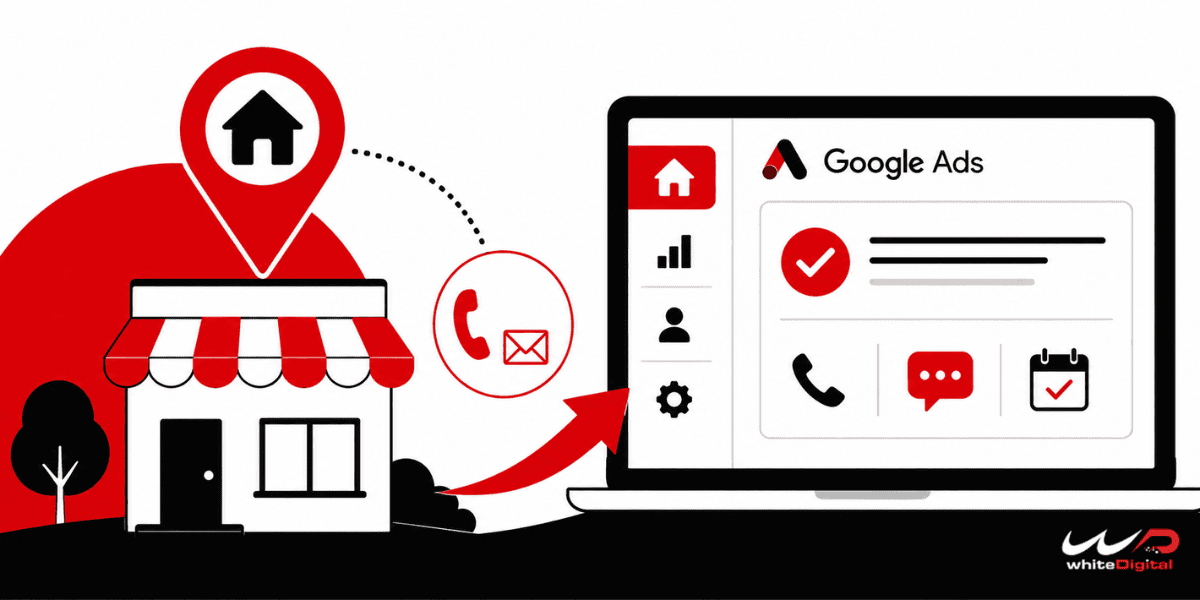
Google is going to integrate Local Services Ads into the Google Ads interface and drive eligible advertisers to switch to a unique Performance Max campaign that focuses on the pay per lead pricing model. This transition is intended to provide advertisers with an opportunity to manage all ads, leads and campaigns in one place, but without losing the main benefit of Local Services Ads.
Under the new system, advertisers can continue to concentrate on engaging customers directly instead of regular clicks on ads.
According to Google, eligible campaigns will be charged for legitimate leads, namely qualified phone calls and messages or emails, when they are enabled. Booking will be introduced as an optional lead conversion starting from October 2026.
It does not mean that LSA will be transformed into regular Performance Max. Pay Per Lead campaigns will be created specifically for local services and focused on Google Search and Google Maps. They do not involve keywords because they use business information and campaign settings.
The transition will be conducted gradually. Eligible existing LSA campaigns will be moved, whereas some businesses will stay with the old LSA portal till the moment the category or region is supported.
Why Google Is Integrating LSA Into Google Ads
The integration of Local Services Ads into Google Ads mainly aims to provide easier campaign management. In the past, Local Services Ads had their own separate platform, which forced local businesses and agencies to run their own advertising processes. Google is integrating Local Services Ads into the larger Google Ads platform, so that businesses can manage their advertisements and generate leads.
A new Performance Max campaign has been developed for businesses that are able to use it to achieve Pay Per Lead targets. The company has claimed that it operates on the same principles as Local Services Ads in terms of connecting with local consumers and creating quality leads. Therefore, the transition will keep the high commercial intent of the product rather than turning Local Services Ads into regular WhatsApp advertising.
The one-stop shop allows agencies to manage different Google services. Teams can use Google Ads to run local lead campaigns. However, the aforementioned campaign has some peculiarities.
The campaign is keyword-based. It has some crucial business information, such as name and location itself synced from a verified Google Business Profile.
This creates a tighter connection between local business information and advertising, making profile accuracy increasingly important for campaign management.
How Pay Per Lead Campaigns Will Operate
Another critical aspect of the migration process will be maintaining Pay Per Lead pricing. Advertisers are not transitioning from a lead-based approach to paying for all clicks. According to Google, the company charges businesses only when a potential customer reaches out to them via an ad and the activity counts as a lead.
Calls are mandatory conversion actions for Pay Per Lead campaigns. According to Google, qualified calls can be completed calls, voicemails, and missed calls followed by returning calls, provided that the minimum duration requirement and lead validity criteria are met. Text messages or emails can be optional lead actions, and bookings are to be made available starting October 2026.
Such an approach works perfectly well for service-oriented businesses since clicks are not always what they want. Local businesses prefer phone calls, inquiries, and appointments rather than traffic. This way, Pay Per Lead pricing matches costs to acquisition.
However, proper setup is needed. Businesses should know which activities can count as leads. Calls are a mandatory activity, so call tracking will be essential during the setup stage.
For service businesses, this distinction matters because advertising expenditure remains connected to customer interactions rather than simply website visits. The model preserves one of LSA’s most important advantages while Google changes the management environment around it.
Features of Pay Per Lead Performance Max
Even though Google has included “Performance Max” in the name of this campaign, it should not be presumed that Pay Per Lead campaigns work in the same way as the regular Performance Max campaign. This particular campaign type is created specifically to help local businesses and to make sure that local users receive needed information in Google Search and Google Maps.
The setup process is quite simple. Google does not use its standard keyword lists but instead allows advertisers to target campaigns by service area, business category, service and ad scheduling. The information provided in the Google Business Profile and some automated processes help the system find potential leads.
Thus, advertisers don’t need large lists of keywords or typical responsive search ads. The Google Business Profile provides such information as the name of the company, the address, the working hours, and reviews of the business.
Besides this, there are some options for customizing the campaigns. The ads can consist of images of the business, callouts, and links to the website for optimizing assets.
For local advertisers, the strategic focus should therefore be relevance, availability, and lead quality rather than traditional keyword-level campaign management.
Who Can Participate in the New Campaign?
Eligibility plays a crucial role in the process since the Pay Per Lead Performance Max experience is not available for all participants. According to the recent information provided by Google, the campaign is available only for businesses that operate in the United States and have at least one verified Google Business Profile and a storefront or home services category.
In addition, some categories need extra verification from Google. There are a few businesses, such as locksmith, garage door services and in some regions where pay per lead Performance experience is not available. Till then, they can use the previous version of Google Local Services Ads.
Google explains that some other categories will become eligible later. In addition, Local Services Ads categories with advanced verification and professional services will be available for the Pay Per Lead Performance Max experience in 2027. Thus, the process of migration depends on business types and markets.
It is vital for agencies to perform necessary eligibility checks because a strategy that will work for one client may not yet be suitable for another. It is also recommended for businesses to verify their Google Business Profile.
The phased rollout moves eligible advertisers gradually. This is a great opportunity to expand the availability to various categories and regions. This will allow businesses to have a changeover from the old to the new Google Ads-based workflow.
Things Advertisers Should Do Prior to Transition
Google’s transition of Local Services Ads (LSAs) illustrates that the local advertising industry is gradually being brought under the Google Ads, while maintaining the economics that make LSAs a popular choice with service providers.
One key point is that the integration of the product is underway instead of the conversion to a regular Performance Max product.
The top priority for advertisers at this point is prepping for this move. In particular, businesses should ensure that their Google Business Profile is up-to-date because it is vital to their campaign, as it is the basis of campaign data. Advertisers must pay attention to all elements, including their geographical area of operation, business categories, types of services they provide, their operating hours and ensure that their phone numbers and lead expectations are accurate.
Agencies should track the benchmark LSA performance metrics before implementation because the export of performance data is an important point of reference later on. All relevant data should be exported before the implementation so as to create a baseline for analysis to compare results.
Coming to an end, this change therefore represents a platform consolidation rather than a fundamental change to how local businesses acquire high-intent leads through Google.