Consistent lead and sales generation through Google Ads provides an excellent opportunity for any company. However, time after time, many campaigns fail despite having plenty of budget because of things that could have been avoided during the campaign process.
Many advertising companies often think that simply spending more money on the campaign will result in better performance, yet more frequently than not, it is a campaign management issue that contributes to poor performance.
If your client’s campaigns aren’t providing the ROI you were expecting from them, then chances are some common mistakes have been made, which are slowly draining out of the cash flow. The good news is these mistakes are typically very visible and easy to fix.
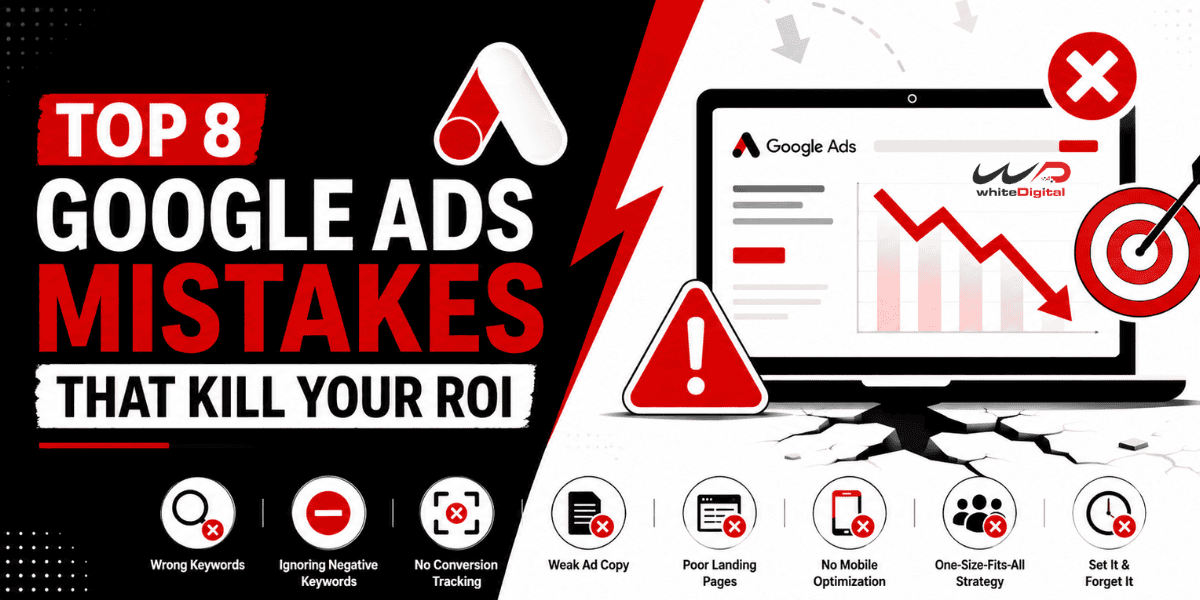
In this article, we will take a look at the top eight mistakes made by advertisers, along with how those mistakes affect their overall performance. We will also look at the practical solutions to help you turn things around and improve your ROI.
- Targeting the Wrong Keywords
Using the wrong keywords is among the most common mistakes in PPC. Businesses tend to use generic keywords without reflecting on what their purpose is.
For instance, when selling premium accounting software, targeting the general keyword “accounting” is too vague. You may be showing your client’s ads to users who search for online courses in accounting, the definition of accounting, or accounting templates.
Effect on ROI
The CPC will be increased with a reduced conversion rates which will lead to unwanted spending and a poor quality score.
How to Solve It Quickly
- Focus on using high-intent keywords.
- Use phrase match and exact match keyword types.
- Make sure that you understand the intent behind the search before adding keywords.
- Pay attention to the Search Terms Report.
- Ignoring Negative Keywords
As you can see, you can spend so much time researching the right keywords that you might forget about using the negative keywords.
Negative keywords protect from having your client’s ads from being shown to people who are searching for something totally unrelated to what you provide.
For example, if you sell a subscription-based B2B marketing tool, you would want to add the following types of keywords as negative keywords, such as Free, Jobs/Careers, Training/Tutorial and Download, etc.
ROI Impact
Unwanted spending increases with a lowered Click through rate and a low conversion rate, which will damage the campaign’s richness.
The Quick Fix
Create and keep an up-to-date list of negative keywords to ensure you are reviewing and adding to the negative keyword lists every week by reviewing the search terms and blocking them if they are costing you clicks without generating revenue.
- Flying Blind Without Conversion Tracking
Launching a Google Ads campaign without conversion tracking is undoubtedly one of the biggest mistakes that you can make. If you are not aware of the specific keywords, ads, or campaigns that drive conversions, you are essentially operating blindly. Clicks are good, but do not cover the costs.
Impact on ROI
This will blind you from getting the exact figures of your client’s ad performance, which will lead to unwanted spending on different campaigns. Like other mistakes, this will also kill the way you optimize the campaign with Google intelligence bidding.
The Fast Solution
Get tracking for the activities that actually make an effect, such as sales and checkouts, Leads form fills out, Phone calls, Quotation request and Newsletters subscription
Now that you have your tracking set up, your client can feel confident making investments in the profitable campaigns rather than in those that only bring traffic.
- Ad Copy That Will NOT Work
The ad copy will not work if the customer base can be clearly defined, but the incentive for the customer to click through is not compelling enough, the campaign’s entire success will suffer. Companies create ad copy that tells you what the product does, but doesn’t explain how that product will help you, nor does it create a sense of urgency/need to buy.
Impact on ROI
The quality of Return on Investment will be damaged with a lowered click through rate and will hit the quality score, which will affect the overall performance of the campaign.
Quick Fix
- Rewrite your messaging to highlight the benefits of the product to the customer, not just features.
- All ads should contain a headline that grabs attention
- Value Proposition
- Trust Symbols (Reviews, Awards, Guarantee)
For instance, try changing “Digital Marketing Services” to “Generate More Revenue Using Professional Digital Marketing – Get your FREE Consultation Here.”
- Sending Traffic to Poor Landing Pages
It’s common to spend days optimizing an ad campaign only to completely neglect the page a visitor lands on after they click. If your client’s landing page takes too long to load, looks outdated, or doesn’t match the promise of your ad, visitors will bounce immediately.
Impact on ROI
When you make such mistake, the bounce rate will rise with abnormal conversions that will cost you more to spend. You will be spending more with a bad rate of conversion that will hurt your quality score.
The Quick Fix
Take a hard look at your landing page and ensure it:
- Perfectly mirror the message and offer of the ad
- Loads almost instantly
- Is fully optimized for mobile devices
- Focuses on one primary call-to-action
- Cuts out unnecessary distractions
- Neglecting Mobile Optimization
With a large number of Google searches conducted on mobile devices, having a mobile unfriendly approach to your website or promoting your client’s services is a serious disadvantage. A mobile user expects to have an easy-to-use page that works quickly and is easy to navigate. If they experience anything else, it will likely be frustrating, and they will either be gone or have great difficulty completing their purchase with you.
ROI Effects
The bounce rates are high as the conversion on mobile are lesser when compared to PC. When the user finds that your client’s website is no longer interesting, they will simply abandon it and move to other sites.
Quick Solutions
Test your landing pages across many devices. Improve mobile performance by reducing image file sizes, reducing mobile forms, utilizing click-to-call buttons and providing larger touch targets. A better user experience on mobile can improve the performance of a poorly performing campaign overnight.
- Using a Single Containment Ad Strategy
A different audience has different pain points that define their decision-making process. The audience targeted with the same generic advertisement will fail.
The person searching for “best CRM software for a start up “is looking for price and ease of use. The person who is searching for “enterprise CRM platform” cares about security, scalability and integrations. These 2 audiences should not have the same ad placed in front of them.
ROI Effects:
The engagement rate decreases as they are irrelevant to what people actually search for. the quality of the ad takes a hit which will make you realize the opportunity to convert has gone.
- The “align and forget” Approach to Google Ads
This is a dynamic world where your client’s competitors are making changes to their bids, looking out for changes and for the algorithm updates.
What worked fantastically well last month might suddenly become inefficient this month if you leave everything as it is.
Impact on ROI
The cost moves higher with a reduced conversion rate and it could kill the opportunity to do better optimization.
The Quick Fix
Schedule regular review of your campaign.
Follow the key metrics every week. These are Click Through Rate (CTR), Conversion rate, Cost per Acquisition (CPA), Return on Ad Spend (ROAS) and Quality scores of your keywords.
Always keep testing headlines, descriptions, landing pages and bidding strategies of your ads. Little changes make wonders in the long run.
Coming to an end, by avoiding these basic errors with Google Ads, you will revolutionize the performance of your client’s ads. Keep optimizing too broad keywords, setting up a negative list, fixing tracking code issues, or improving landing pages. These mistakes will cost you and your client’s budget.