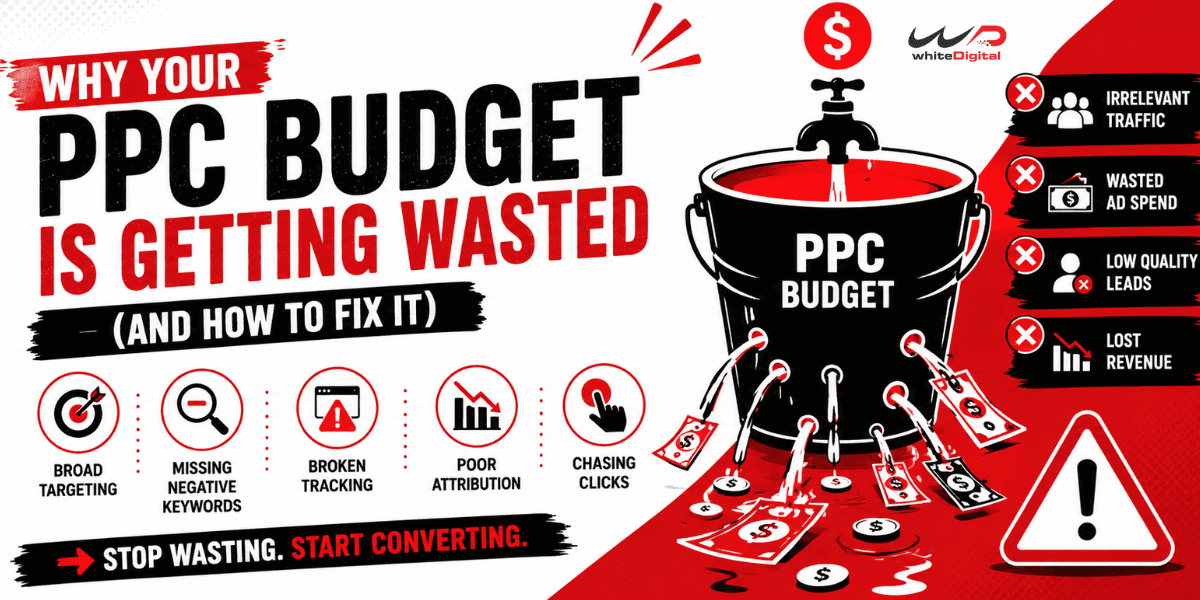
Every business owner or marketing director believes their advertising budget should be working harder.
The problem is, most of them don’t realize where the cash is actually draining out.
It’s easy to point fingers at rising cost-per-click (CPC) rates or aggressive competitors. But after auditing dozens of PPC accounts over the years, one glaring pattern appears again and again that is the budget isn’t disappearing because Google Ads has suddenly stopped working. It’s disappearing because campaigns are quietly paying for the wrong traffic.
A broad keyword here and a missing negative keyword there. Conversion tracking that had been secretly broken three months ago. Individually, these hiccups seem minor. Together, they form a massive blind spot that drains thousands from your bottom line without raising a single red flag.
The good news? This PPC budget waste is entirely fixable. Here is how to plug the leaks.
- Broad Targeting Isn’t Always Smart Targeting
One of the fastest ways to burn through an ad budget is to try to be everything to everyone.
Many advertisers launch campaigns with broad targeting because they are terrified of missing out on potential customers. Ironically, that’s exactly how they end up footing the bill for clicks from people who have zero intention of buying.
Imagine your client sells premium, high-end office furniture. If the ads start showing up for searches like “DIY desk ideas” or “cheap study table under $50”, your client is paying for clicks that have absolutely no commercial value to them.
More impressions don’t equal better performance. The tighter and more precise your audience, the higher your chances of turning a casual click into a paying customer.
- Negative Keywords Are Not Optional
If there is one clear line dividing elite PPC accounts from the completely average ones, it’s how they handle negative keywords.
Most advertisers spend all their time brainstorming keywords they want to target. Very few spend enough time deciding which searches they want to completely avoid. That’s an incredibly expensive mistake.
Without a robust negative keyword list, Google’s algorithm will match your client’s ads with searches that are only loosely, hypothetically related to the business. Every single irrelevant click chips away at your daily budget.
Reviewing the search terms report at least once a week and aggressively expanding the negatives is one of the most effective PPC optimization tips you can implement for your client’s campaign today.
- Your Tracking Might Be Lying to You
This is the issue that catches even beginner marketers completely off guard.
The dashboard says the campaigns look incredibly profitable. Conversions appear to be climbing month over month. The reports you hand to leadership look fantastic.
Then, somehow, you actually dig into the tag setup and uncover duplicate conversions, missing purchase values, or contact forms that aren’t actually being recorded at all.
Bad tracking leads to bad decisions. If Google is fed inaccurate conversion data, its smart bidding algorithms will optimize for the wrong outcomes. Budgets start flowing toward campaigns that look brilliant on paper but aren’t driving an ounce of actual business revenue. Before you even think about scaling how much you have spent, verify that your tracking is measuring what actually impacts your client’s bank account.
- Attribution Tells a Bigger Story
Customers rarely see an ad, click it and buy right then and there. It’s just not how humans shop anymore.
A prospect might discover your client’s brand through a top-of-funnel Google search, return to the site a few days later via a retargeting ad on social media and finally buy after opening an email newsletter.
If your client’s account is set to a model that only gives credit to the very last click, you are missing the entire story. Modern data-driven attribution models provide a much more realistic view of how different campaigns work together. When you understand that journey, your client can invest heavily in the channels that actually influence the final purchase decision, rather than just the ones that happened to be standing there when the door closed.
- Stop Treating Every Campaign the Same
Not every product or service deserves an equal slice of the pie. Yet, it’s shockingly common to see businesses spreading their ad spend evenly across every single campaign, product line, or region.
That is rarely an efficient way to operate.
High-performing campaigns need breathing room to scale. Underperforming campaigns should not keep eating up budget just because they have always been active. Budget allocation should be driven by cold, hard performance data, not by habit.
- Chasing Clicks Instead of Customers
High click-through rates (CTR) feel great. They look flashy in a monthly report and make you feel like people care about your client’s brand.
But clicks don’t pay the bills. Revenue does.
One of the greatest mindset shift you need to make is focusing less on raw traffic and significantly more on business outcomes. A campaign that drives fewer clicks but pulls in highly qualified, high-intent leads is infinitely more valuable than a campaign driving thousands of random visitors who bounce within three seconds.
The ultimate goal isn’t to buy more traffic. It’s to buy better traffic.
A Simple PPC Audit You Can Do Today
If you suspect your client’s money is slipping through the cracks, take 20 minutes to run through this quick checklist:
- Are the target keywords attracting actual buyers, or just information seekers?
- Have I added new negative keywords in the last 7 days?
- Are the conversion tracking accurately recording unique actions and values?
- Which 20% of my client’s campaigns are driving 80% of my revenue?
- Are dead-weight campaigns still allowed to consume the daily budget?
- Have I analysed through the actual search terms report for the last 30 days?
- Am I judging campaign success on profit and conversions rather than clicks?
If you answered no or I’m not sure to more than two of these, your client’s account has immediate room for improvement. Small, consistent tweaks to reduce ad spend waste almost always outperform massive, chaotic account rebuilds.
Coming to an end, there is no such thing as a perfect PPC account. Every campaign has minor inefficiencies.
What separates successful brands from the ones losing money isn’t that they never make mistakes. It is that they catch them before they become devastatingly expensive.
Treat optimization as a continuous weekly discipline, not a quarterly chore. The goal isn’t just to spend less money; it’s to make every single dollar work twice as hard.
Frequently Asked Questions
- What causes the most PPC budget waste?
In almost every account audited, the primary culprits are overly broad keyword targeting, a lack of negative keywords, broken conversion tracking and leaving underperforming campaigns on autopilot.
- How often should I audit my client’s PPC campaigns?
For most businesses, a comprehensive monthly audit keeps things on track. However, high-spend accounts or fast-moving industries require weekly check-ins on search terms and budget pacing to ensure things don’t go off the rails.