
Search is no longer just a list of blue links. In 2026, Google’s search experience feels more like a conversation layer sitting on top of the internet. Users ask broader questions, receive summarized answers instantly, and often get what they need without opening five different tabs. At the centre of this shift are AI Overviews, Google’s AI-generated summaries that now appear across a growing number of search queries.
And where attention goes, advertising follows.
For marketers, this is not just another interface update. It is a structural change in how discovery, clicks, and purchase intent work online.
What Are AI Overviews?
AI Overviews are generated answer boxes provided by Google. While previously Google showed only typical search result listings, nowadays the search engine aggregates information and creates summaries.
It’s like searching for something in a very smart search engine.
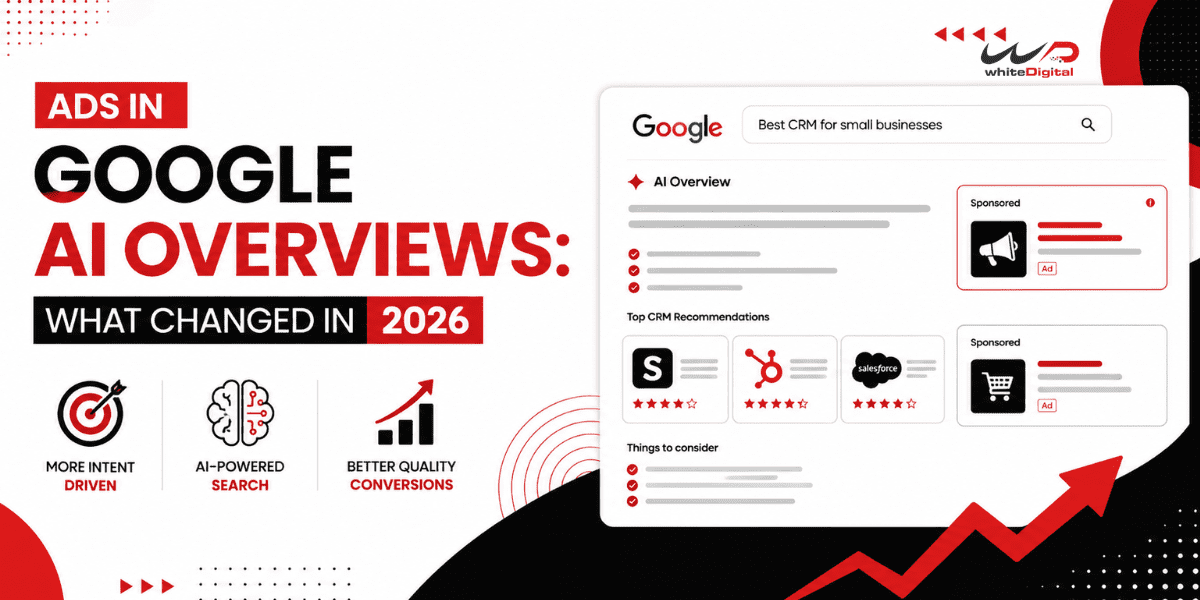
A person who wants to learn what the best CRM for small businesses would be will see such a result as:
- A summary comparison
- Key features across platforms
- Buying considerations
- Product recommendations
- Follow-up prompts
Without needing to scroll down further to regular listings.
That change had a huge impact on how people use search results. It changed the way users interact with Google’s interface, using answers provided rather than moving immediately to the site.
How Ads Became a Part of AI Results
The major update is related not to AI but to advertisements. In the past, ads were located above or below the regular search listings.
Nowadays, sponsored content can be seen within and around the answer box:
- Sponsored product recommendations
- Context-aware text ads
- Shopping placements integrated within AI summaries
- Brand suggestions linked to user intent
- AI-assisted comparison panels featuring promoted businesses
In many cases, these ads feel less intrusive because they are embedded naturally into the flow of information. Instead of interrupting the experience, they appear as part of the recommendation journey itself.
That has made Google AI overview ads significantly more intent-driven than older search placements.
A user who reaches an AI-generated comparison panel is often further along in decision-making than someone casually browsing search results. The volume of clicks may decrease, but the quality of those clicks is improving.
The Traffic Shift | Fewer Clicks, Better Intent
One of the biggest concerns surrounding AI-driven search has been traffic decline.
And yes, many publishers and businesses are already seeing reduced organic click-through rates because users can get quick answers without visiting websites.
But the story is more layered than “traffic is dying.”
The real shift is this:
Search traffic is becoming filtered.
Users who still click are often doing so with stronger intent, clearer questions, and higher purchase readiness. Random exploratory clicks are decreasing. Decision-stage interactions are increasing.
For advertisers, this changes how performance should be measured.
Instead of obsessing only over click volume, brands now need to focus on:
- Conversion quality
- Assisted conversions
- Branded search lift
- Engagement depth
- Customer acquisition efficiency
The brands adapting fastest are not chasing more impressions. They are building smarter relevance.
Why Traditional Search Ad Strategies Are Losing Edge
Many legacy Google Ads strategies were designed around keyword matching and aggressive visibility.
That approach is becoming less effective inside AI-driven search experiences.
AI-driven search results are highly dependent on context, intent, and semantics. Google understands what you intend by your queries, rather than what you type into the search engine.
In this regard, any brand or advertiser that depends solely on keywords and their exact match to get found will gradually lose to those who demonstrate greater contextual relevancy.
What’s Ahead for Paid Search Marketing?
- Greater audience insight
- More diversified content environments
- High-authority landing pages
- Strong first-party data
- AI-assisted campaign optimization
With growing adoption of ad-supported AI solutions, marketers have to become more strategic than ever before when developing their ad campaigns.
How Brands Should Adapt in 2026
Brands that will succeed in this new environment will be those which do not resist AI-led searches but rethink their strategies based on this new trend.
Here are the biggest shifts brands should focus on:
- Importance of Intention over Keywords
Keywords are not obsolete anymore, but intention mapping becomes even more critical.
As opposed to trying to reach people through certain keywords, companies need to create campaigns based on user intent:
- Discovery
- Evaluation
- Comparison
- Preparation for purchase
Search experience powered by artificial intelligence gives value at each step of the buying process.
- Create More Intelligent Ads
The AI search environment will showcase advertisements differently. The uninformative text won’t be around for very long. The companies have to come up with smart text, which conveys credibility, authority, value, and good landing pages.
- Use AI-Powered Campaign Structures
Google is increasingly prioritizing automated and AI-assisted campaign formats.
Modern AI search Google ads strategies now rely heavily on:
- Performance Max campaigns
- Audience signals
- Predictive targeting
- Automated bidding intelligence
- Cross-platform behavioural insights
The advertisers treating AI as a collaborative system, rather than fighting automation, are seeing stronger efficiency gains.
- Strengthen Brand Presence Beyond Search
As AI answers reduce casual website visits, brands need stronger recall outside Google itself.
That includes:
- Thought leadership content
- Video marketing
- Community building
- Social proof
- Email ecosystems
- Creator collaborations
The stronger the brand familiarity, the more likely users are to engage when your business appears inside AI-generated recommendations.
The Future of Search Advertising
Search advertising is not disappearing. It is evolving into something more layered, predictive, and intent-focused.
The old model was built around visibility.
The new model is built around relevance inside AI-assisted decision-making.
For marketers, this means adapting to an environment where:
- Fewer clicks can still produce better revenue
- Context matters more than raw keyword volume
- AI influences both discovery and conversion
- Brand trust becomes a ranking signal in itself
Coming to an end, the businesses that understand this early will have a major advantage as the future of search ads continues to unfold.
In this upgraded digital world, if you want to get better search visibility, getting the top result in the search page is not just enough. You should aim to give relevant answers to the queries.