
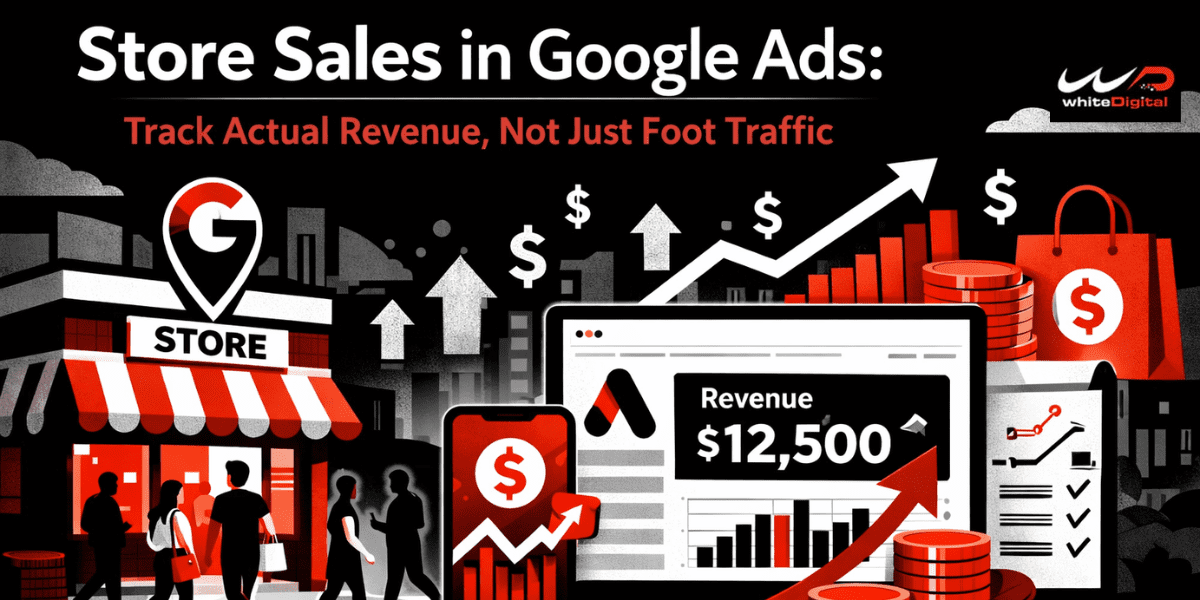
Store visit tracking in Google Ads has evolved a lot. But visits alone don’t pay the bills. What really matters is connecting your online ads to real purchases people make in your store.
Clicks and impression statistics can tell us how people engage with our ads online. Even offline visitations are not a definite proof of whether someone made a sale. That’s exactly where store sales conversion in Google Ads is relevant.
Through the new feature of offline conversion tracking available in Google Ads, businesses can evaluate how well their advertising activities affected their offline sales. The feature enhances retail attribution in Google Ads by enabling you to optimize your advertising budget based on revenue.
What Is Store Sale Conversion in Google Ads?
The Store Sale Conversion tool will allow you to track true offline sales created because of Google Ads activity.In other words, rather than using estimates, the feature relies on actual transactional data to measure revenue generated from ads.
Overall, the mechanism uses the customer purchase information collected through your POS or CRM to match the offline buyers who previously engaged with your ads.
Measures real offline purchases, not visits, and uses first-party customer data (email address/phone number/loyalty ID)
Store Visits vs Store Sales | Why the Difference Matters
It is important to comprehend their meanings as well as understand how they differ to get accurate results from your measurements.
Store Visits (Measure Based on Location Data)
In simple terms, Store Visits measure the number of visits to your location based on footfall that follows from ad interaction. This measurement is done based on location data modelling.
What Store Visits tell you:
- Number of visits to your location
- Effectiveness of advertising campaigns at drawing foot traffic
Drawbacks:
- Does not verify any purchases
- Probabilistic data
- No information on revenue
Store Sales (Measure Based on Transactional Data)
As compared to the former, Store Sales Conversion measures actual in-store purchases by the target audience.
What Store Sales Conversion tells you
- Identifies customers who bought something after ad interaction
- Revenue earned through ads
- Which campaigns lead to actual conversions
Quick Comparison
- Store Visits to the footfall-based metric
- Store Sales to transaction-based metric
- Visits to modelled data
- Sales to transaction data
This is the core reason why store sales conversion on Google Ads matters.
Linking Store Sales Conversions to Store Transactions
Although the process may seem sophisticated, it follows an organized process.
Process Overview
- Process 1: Ad Interaction
User interacts with your ad on Google’s network
- Process 2: In-Store Transaction
The same user goes to your store and makes a purchase
- Process 3: Collect Data
POS or CRM collects sales data
- Process 4: Secure Data Upload
Customers’ personal data is encrypted and sent to Google
- Process 5: Matching and Attributions
Google matches these details with signed-in users
- Process 6: Reporting
The sale becomes a conversion attributed to the campaign in the dashboard
Why Is It So Effective?
- Lowers costs by tying online ads -> revenue
- Accurate retail attribution in Google Ads
- Optimizes campaigns for purchasers rather than just traffic
Where This Feature Is Most Relevant
Store Sales Conversion in Performance Max Campaigns
A campaign that would benefit the most from this feature is Performance Max with store goals.
These campaigns leverage automation through many Google products to accomplish both online and offline results.
Some of the channels used include:
- Search
- Display
- YouTube
- Discover
- Google Maps
How the Feature Helps Performance Max Campaigns
- Targets campaigns towards profitable customers who visit stores
- Optimizes bidding based on actual sales data
- Changes the focus from traffic to generating revenue
This feature works best for:
- Retailers with several store locations
- Brands with significant offline sales
- Companies conducting omnichannel advertising
This scenario is when it really makes sense to track store sales.
Why the New Store Sales Conversion Is Important for Retailers
This new feature is a remarkable tool for today’s advertisers in many ways.
Features
- ROAS Measurement
See how much revenue your advertising generates
- Better Budget Management
Determine which campaigns are profitable
- Audience Optimization
Find profitable customer audiences
- Complete Funnel Analysis
From ad impression to store conversion
Requirements and Eligibility
Requirements
Store Sales Conversion is inaccessible to all advertisers by default. Some conditions must be met according to Google’s guidelines.
- Has to be allowed on the list by Google
- Has to have sufficient transactions
- Needs first-party data collection
- Has to be integrated into POS or CRM systems
Not Suitable For
- Small companies with low transactions
- Businesses that do not gather their customers’ information
- Web-only shops
Constraints to Take into Account
It is crucial to know the limitations of this tool, despite its high effectiveness.
Main Constraints
- Data matching can not be 100% precise
- There may be some delay in reporting.
- A strong data foundation is needed
- Must adhere to privacy rules
Coming to an end, the introduction of store sales conversion in Google Ads is one of the significant changes that have occurred in terms of advertising campaigns. Rather than being satisfied with clicks and visits only, businesses now have the opportunity to concentrate on the most important thing, like revenue.
As it helps enhance the tracking of offline conversions and attribution within Google Ads, store sales conversion enables more informed decisions about advertising campaigns and their effectiveness.