
When Google dropped the AI Max campaign framework back in May 2025, many advertisers’ agency Slack channels immediately blew up.
On one side, you had the tech-optimists, raving about the promise of effortless reach and predictive targeting. On the other side were the seasoned media buyers, the ones who bear the scars of every automation push that Google has forced on us over the last decade. We weren’t eager to hand over the keys to yet another hindrance that appears.
Fast forward to Google Ads 2026 and the good days and the panic are over. The high-level theoretical debates have ended up and left with the only question that actually matters to a client, Is AI Max actually worth trusting with your hard-earned budget?
Let’s skip the marketing side and look at how this tool is actually performing on the ground.
A Quick Reality Check: What Is AI Max, Anyway?
If you missed the rollout last year, here is the shorthand that is the Google AI Max campaign was built to push advertisers past the boundaries of traditional keyword targeting.
Instead of just bidding on the exact terms you type into your ad group, AI Max for search analyzes your landing pages, your actual ad assets, historical performance data and real-time user intent.
If a customer is searching for something highly relevant to your business, Google’s AI will slip you into the auction even if you don’t have that specific keyword in your account.
For brands desperate for scale, it sounds like magic. For media buyers who obsess over negative keyword lists and tight match types, it sounds like an existential nightmare.
Why to Proceed with Caution in 2026
Let us be clear that search marketers don’t hate AI. Most of the advertisers have been leaning heavily on Smart Bidding and Responsive Search Ads for years. Their hesitation with Google AI Max for search wasn’t about the technology but it was about control and visibility.
Last year, many advertisers ran into three glaring issues:
Search Query Expansion
Campaigns built around high-intent, bottom of the funnel leads suddenly started pulling in top of the funnel, informational traffic. Advertisers were not buying buyers but were buying browsers.
The Transparency challenge
Google’s reporting originally offered zero insight into why the AI chose to expand into certain auctions. It is a tough pill to swallow when you are managing six-figure monthly budgets.
Budget Inefficiencies due to the Learning Phase
More clicks are great for Google’s bottom line, but advertisers care about conversions. Early on, a lot of budgets were burned while the machine learned what worked and what did not.
Growth without guardrails isn’t a strategy, it’s just an expensive game.
The Turning Point is to Enter the Guardrails
Thankfully, the collective feedback of frustrated agencies actually made an impact.
Advertisers have been struggling to handle accounts in Google Ads, but with the recent update, it’s a relief. The platform has introduced critical guardrails that flipped the plate and made it more comfortable for the advertisers.
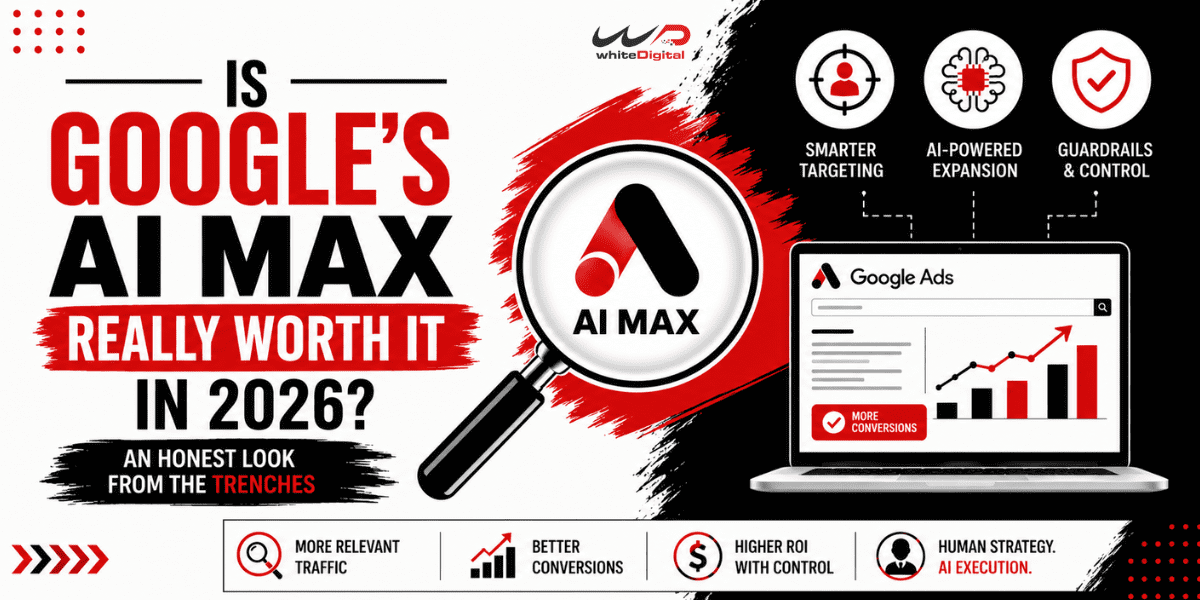
Advertisers no longer have to give the machine a blank guess. The newer controls allow setting strict boundaries on where expansion happens, giving advertisers the power to veto irrelevant placements while still letting the AI hunt for conversions within a safer perimeter. This shifts from advising clients to avoid it entirely to actively building it into testing roadmaps.
AI Max vs. Traditional Search: The Verdict
Here is the biggest misunderstanding that can be seen right now is that AI Max campaign is not a replacement for a meticulously structured Search campaign.
If anyone advises to delete the keyword campaigns and go all-in on automation, ignore them.
Deploying AI Max for search works best as an enhancement layer. It sits on top of your core strategy to catch the high-converting search queries that are too niche, too long-tail, or too unpredictable for the standard keyword lists to catch.
Where It Wins (and Where It Bombs)
Many advertisers have run enough data through this system by now to see the patterns.
Green Light: When to Use It
- Data-Rich Accounts – the pixel and conversion tracking are flawless and you have months of clean the historical data.
- Stable Performers – Your client has a campaign that consistently hits its ROAS/CPA targets and just needs more volume.
- Broad Appeal – Your client’s product or service doesn’t require hyper-niche, legally sensitive targeting.
Red Light: When to Step Back
- Brand New Accounts – If the machine doesn’t know what a good customer looks like yet, it will be a waste of money finding out.
- Micro-Budgets – If the daily budget is tight, your client can’t afford the luxury of the AI’s learning phase.
- Highly Regulated Niches – If a single wrong keyword could land your legal team in hot water (looking at the Finance and Healthcare), stick to exact match.
The Smart Marketer’s Playbook for Safe Testing
If you are ready to test the waters, don’t dive headfirst. Use this step-by-step approach that actually works with your clients:
- Isolate the Experiment – Do not roll this out across the entire account. Pick one stable, middle-of-the-road campaign with a predictable baseline to test against.
- Stalk the Search Terms Report – Guardrails or not, you need to check the search terms weekly. Snip out irrelevant queries early before they eat your client’s budget.
- Define Success by the Bottom Line – Google will show you pretty charts of rising impressions and clicks. Ignore them. Focus strictly on your cost-per-acquisition (CPA) and pipeline value.
- Let it Cook- Machine learning requires patience. If you panic and tweak the budget or target every 48 hours, you will reset the algorithm’s learning phase and get skewed data. Give it at least two to three weeks of uninterrupted runtime.
So, Is It Worth It?
To navigate Google Ads in 2026, the answer would be a yes, but it happens only when the ship is handled by the captain.
The Google AI Max campaign has officially grown up. The addition of robust guardrails has turned it from a reckless traffic-driver into a sophisticated tool for scale. But remember, automation is a tactic, not a strategy. The brands winning right now aren’t blindly trusting the machine. They are using Google AI Max for search to do the heavy lifting of exploration, while keeping the strategy, the guardrails and the final budget decisions firmly in human hands.