
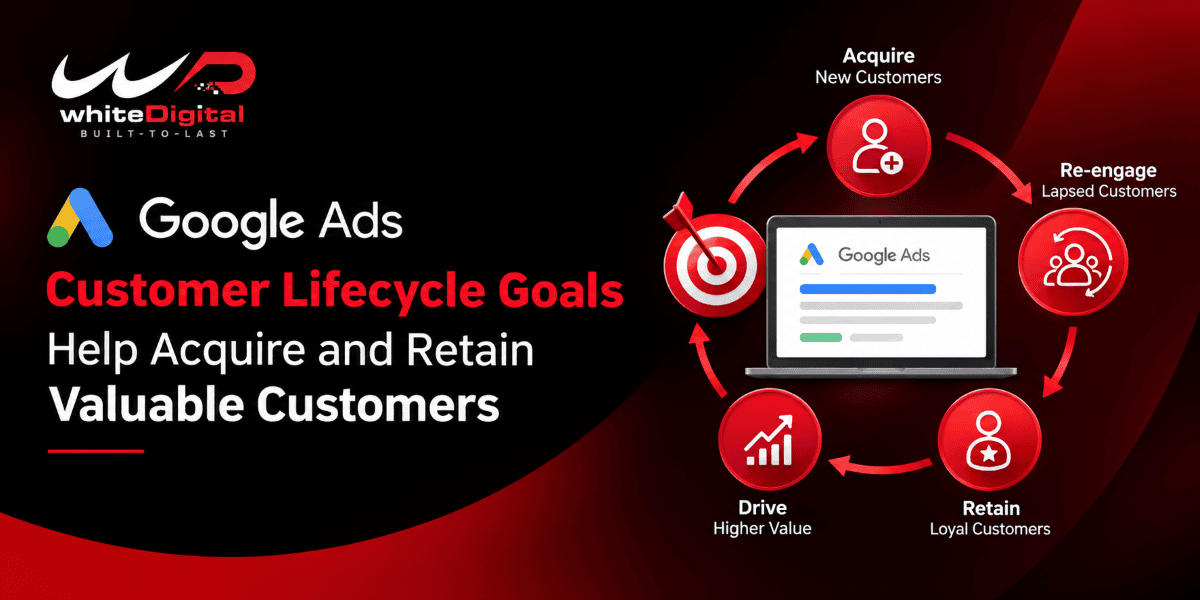
With Google Ads, there are customer lifecycle goals which will allow the advertisers to consider various stages of the customer lifecycle, starting from acquisition of new customers to re-acquisition and retention of loyal customers. Customer lifecycle goals are supported by Smart Bidding in Google Ads to assist businesses in targeting the right customer segments.
As opposed to optimizing campaigns based on conversions or sales alone, customer lifecycle goals will enable advertisers to provide Google Ads with better insights regarding the types of customers they want to target.
Customer Acquisition Helps Businesses Reach New Buyers
In customer acquisition campaigns, advertisers can set Google Ads to focus on acquiring new customers when making bidding decisions. Google offers three choices for this purpose.
New Customer Value
New Customer Value option enables advertisers to bid higher for new customers compared to existing customers, while still reaching both categories. This may come in handy for companies that are looking to expand their customer base without having to exclude repeat buyers.
For instance, an e-commerce site selling clothes may wish to target new customers while still advertising their new line of products to those who have bought from them before. This is where the setting comes in handy, as it will help Google AdWords target new customers but still allow the campaign to make sales from existing customers.
Google recommends this setting for advertisers who have set up purchase conversion goals.
High Value New Customer
Some customers will bring in more revenue than others do. This setting allows advertisers to place emphasis on targeting new customers that are likely to be high-value.
For instance, a furniture outlet will realize that customers buying a full set of beds are more profitable than those purchasing individual furniture. In this regard, by identifying valuable customers and setting the bids through their own company data, advertisers allow Google Ads to bid more aggressively for such new prospective clients.
This setting applies to both search and Performance Max campaigns and must use value-based bidding.
New Customer Only
The New Customer Only setting enables advertisers to make bids only on the basis of new customers. As opposed to the New Customer Value setting, which is allowed to keep engaging old customers, the setting is used for those cases when obtaining new clients is an issue.
The setting could be helpful for companies operating with a tight budget for customer acquisition or advertisers interested in leads rather than conversions.
For instance, a company offering a new product would be interested in making sure that its campaign obtains new clients rather than the ones who have already been purchasing from the company. In this case, it should be planned to run separate campaigns to attract old customers.
Customer Retention Helps Businesses Reconnect with Existing Customers
Getting a customer is just one aspect of building a business. Getting your old customers back and staying in touch with your loyal customers will also help generate revenue for your business.
Google Ads allows you to set up three customer retention options that will help advertisers target their campaigns towards lapsed customers, valuable lapsed customers, and loyalty program members.
Re-Engagement
In the case of the Re-engagement option, the business can get back in touch with customers who haven’t purchased or interacted with the brand for some time, which is defined by the business itself.
For instance, the online beauty shop can have clients who bought the skincare products six months ago but haven’t visited the website ever since. The business can use the customer data and make Google Ads bid on their behalf in order to reach out to those particular customers.
Customer Match lists allow advertisers to find lapsed customers and share the information about the audience with Google Ads in order to attract them.
High Value Re-Engagement
All inactive clients are not equal when it comes to the value they provide to the business. Some might have ordered often, bought expensive products, or even contributed more money than other customers before becoming inactive.
The High Value Re-engagement option helps advertisers to reach out to such valuable clients.
For instance, a business selling expensive electronics will be interested in targeting those customers who used to buy expensive products from them in the past, but haven’t made any purchases for a very long time.
Such an approach enables companies to concentrate their efforts.
Loyalty Program Members
The Loyalty Program Members setting helps businesses reach and retain customers who belong to their loyalty programs.
For example, a retailer may offer members exclusive discounts, special prices, or shipping benefits. Google Ads can use loyalty program information to support eligible Shopping and Performance Max campaigns, including showing member benefits and bidding more competitively for loyalty program members when the relevant settings are enabled.
This can help businesses maintain engagement with their most loyal customers and encourage repeat purchases.
Campaign Types That Support Customer Lifecycle Goals
Different customer lifecycle settings can be used in Google Ads campaigns for Search, Shopping, Performance Max, and Demand Gen campaign types. However, depending on the specific setting and bidding strategy, certain settings are not available.
Settings for customer acquisition include New Customer Value and New Customer Only. The High Value New Customer setting is available for Search and Performance Max campaign types.
Settings for customer retention have less availability. Re-engagement and High Value Re-engagement are available for Performance Max campaign type, while Loyalty Program Members is available for Performance Max and Shopping campaign types.
Requirements for each setting must be reviewed by advertisers before any changes in the campaign configuration.
What Advertisers Need Before Getting Started
Customer life cycle objectives perform better if Google Ads has adequate details regarding customer segments and prospects.
An advertiser can use first-party data like customer match lists, web traffic lists, mobile traffic lists, and audience lists to aid in the process of identifying desired customers. A Customer List should be compliant with Google’s criteria, which include having at least 100 active members on at least one network.
If a campaign is focused on making sales, advertisers should have an accurate purchase conversion set up as well. Conversion values and customer information can help Google Ads know if it’s dealing with a new customer, an existing one, or a lapsed customer.
In terms of companies making use of customer retention settings, it is important to know how long a customer remains active in your sales cycle. For instance, in a grocery store chain, three months without a sale could define an inactive customer, while a longer period might do for a business that sells furniture.
Finally, one needs to evaluate the effectiveness of the approach through results monitoring.
Final Thoughts
Google Ads customer lifecycle goals help advertisers to match their bidding with business needs. Settings for customer acquisition will be useful when advertisers want to target new customers, whereas customer retention settings will be used in an attempt to win back dormant customers and maintain relationships with loyalty program participants.
Such an approach helps businesses to have greater control over targeting certain customer segments. With the use of customer data, suitable bidding strategies, and performance tracking, advertisers can utilize customer lifecycle goals in order to achieve customer growth.