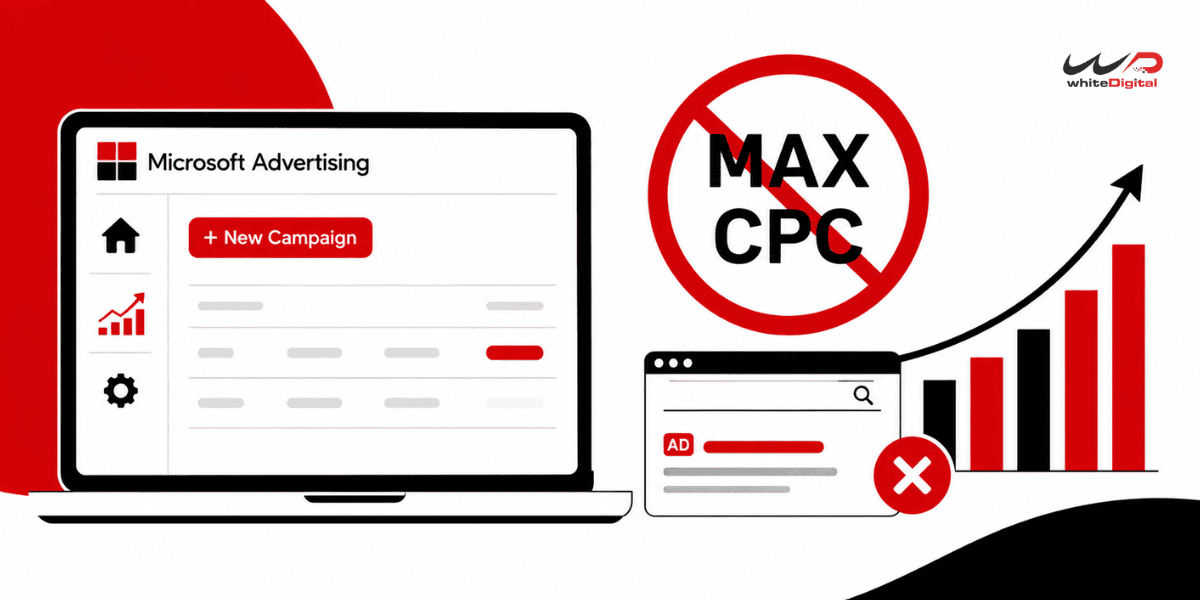
There will also be changes concerning how advertisers can control their bids on new campaigns in Microsoft Advertising. Starting from October 1, 2026, there will be no possibility of using Max Cost Per Click when launching new non-portfolio campaigns which utilize such bid strategies as Target CPA, Target ROAS, Maximize Conversions, Maximize Conversion Value, or Maximize Clicks. It does not mean that the feature will be eliminated everywhere. Existing campaigns that were launched before October 1, 2026 will still have the option, as well as portfolio bid strategies, Enhanced CPC, and Target Impression Share.
The modification is caused by Microsoft’s tendency to automate the bidding process. The company states that using Max CPC might interfere with its optimization tools, even if an advertiser sets the bid ceiling higher than the average bid for the campaign. In other words, an advertiser could ask the system to reach certain goals while limiting the aggressiveness of its actions during each auction. Such goals might interfere with each other when there is an occasion for the system to make a more aggressive bid.
In addition, Microsoft has recently improved the effectiveness of its automated bidding tools. The shift therefore increases responsibility for conversion tracking and goal quality.
Why Microsoft Is Removing the Max CPC Control
Max CPC has offered protection to advertisers in the form of limiting the amount the system will bid on any one click. This option has proven particularly appealing to marketers who require automated bidding but need assurance of having an auction-level cap. Microsoft’s recent change is based on another idea: allowing goals and conversion data to define bids rather than the strict cap on CPC.
As described by Microsoft, Max CPC can get in the way of automated bidding even if the maximum is larger than the campaign’s average CPC.
Microsoft has also worked on making its automated bidding tools more responsive to changes.
What Changes on October 1, 2026?
However, the deadline only affects campaigns that are not within the portfolios. The change starts with campaign creation in the Microsoft Advertising UI first. Microsoft Advertising Editor will also be unable to use the feature, but the timing is unknown in addition, a separate API change will come later.
There are other important exceptions.
Microsoft’s notification fails to clarify the interaction between the changes and the following processes, campaign creation via API, bulk campaign creation, and campaigns created through experiments.
How Should Advertisers Change Their Bidding Approach?
The first major difference is that advertisers cannot use Max CPC anymore as a safeguard when launching automated campaigns. On the contrary, Microsoft advises using controls that are directly linked to business results.
First, perform an audit of conversion tracking. Automation of bidding can work only based on the data it gets. Primary conversions need to signify real results, while unimportant conversions need to be filtered out and the conversion values need to reflect the value of customers. Otherwise, eliminating the CPC limit can worsen inefficiency instead of solving it.
When companies still need hard control of the cost per click, portfolio bidding may represent the most explicit path forward for the new campaigns. But portfolio approaches focus campaigns based on a common bidding target and thus will affect budget allocation and optimization processes. Agencies need to estimate this effect before moving campaigns in order to keep the Max CPC approach.
The task here is not only to retain previous controls, but to construct bidding approaches which guarantee profitable performance post October 1.
The Significance of the Move for Automated Bidding
The move at Microsoft fits into a larger trend in the realm of paid search, whereby platforms expect advertisers to set the outcome that they wish to achieve, whereas the algorithms set the bid for every auction. This is different when it comes to setting a maximum ceiling on the cost per click, since here the cost of the single click is capped irrespective of the value of the opportunity.
This is significant, as a campaign which seeks conversions can find itself facing an auction scenario that presents very valuable customers, but where the cost per click will be capped and will not enable the system to bid enough to capture the opportunity.
The change fits into a trend at Microsoft, which sees it moving towards the consolidation of its bidding tools, and which recently saw Microsoft drop options such as standalone Target CPA and Target ROAS options from the list of new campaigns.
Ultimately, this move comes down to who holds the reins on price variance at the auction level.
Key Points for Microsoft Advertisers
Although there has been a change in Max CPC in Microsoft, it is not something to be worried about, as the date of implementation, October 1st, 2026, only applies to the way the advertisers’ campaign creation process will work from now on.
Clients from advertising agencies should look at the processes related to campaign work, bulk management, editor, and API integrations. Additionally, advertisers have to understand which campaigns require the existence of a CPC ceiling and which of them can take advantage of outcome-based control based on outcomes.
Coming to an end, the first thing to do for campaigns planning on moving into automatic bidding is the optimization of data. Make sure you check conversion actions, conversion values, attribution, budget, and objectives before launching new campaigns. If possible, it is advised to run trials and check the outcomes.