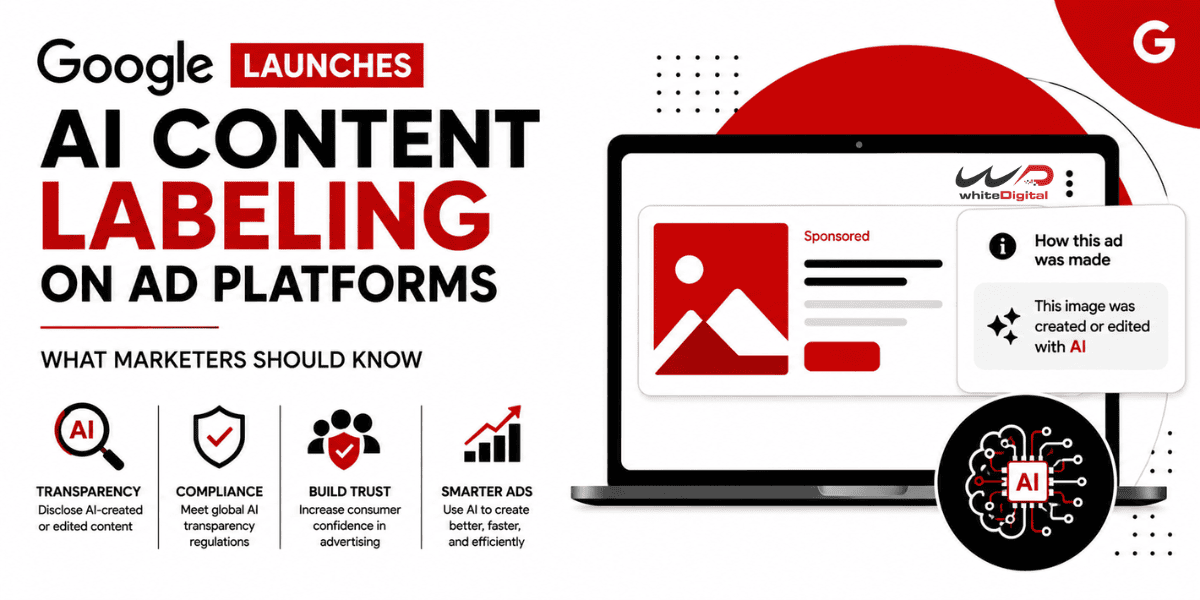
With the growing role of generative AI in digital marketing, transparency is becoming as vital as creativity itself. In order to address this need, Google has recently launched AI content labels across its advertising platforms that will give marketers an opportunity to clearly disclose whether ad creative assets have been created or edited by artificial intelligence.
This initiative is aimed at helping companies meet the rising regulations on transparency in AI use and increase consumer trust at the same time. It is also one more step in Google’s strategy of making AI-based advertising more transparent.
What Are Google AI Content Labels?
Google’s new AI content labels provide marketers with an opportunity to flag images and videos utilized in ads created or significantly modified by means of AI technology. This feature is now available in Asset Studio and is being rolled out gradually across all Google Ads, Display & Video 360, Campaign Manager 360, Merchant Centre and Ads Editor.
In case the asset has been created or edited using AI technology offered by Google, the labeling will be done automatically.
What is Behind Google’s Decision to Apply Such Labels?
The new initiative follows a trend of governments worldwide requiring greater transparency about the use of AI. The regulations in jurisdictions like the European Union, India, and New York are making businesses disclose if they use AI in generating any content, especially content that might affect consumer choice.
In contrast to making disclosures an add-on, Google integrates the process directly into the process of advertising.
Where Are People Going to See Those Labels?
Consumers will be able to find out details about the usage of AI in producing advertisements from the “How this ad was made” feature of Google. Consumers can see it by opening a menu in the form of three dots or clicking on the info icon on ads in Google Search, YouTube, and Discover. In some markets, consumers will be able to see labels of AI in advertisements directly.
Implications for Advertisers
This change does not put any restrictions on the usage of AI by marketers; however, it simply suggests that disclosure of AI in advertising is necessary. Indeed, AI technology may still be used to create creatives, resize assets, create variations of images, and speed up the production of campaigns.
Yet, advertisers need to check their workflow when it comes to creatives and decide whether:
- AI-generated assets need disclosure
- Assets that get automatic labels by Google
- The way third-party AI-generated content will be identified before the launch;
- Internal compliance processes may need to be updated.
Embedding such checks into the campaign production process now will help you to prevent problems in the future due to changes in AI regulations.
Coming to an end, it can be stated that AI content labels from Google are a big step forward in transparency in digital advertising. As AI-generated creatives become more popular in the industry, the disclosure will become standard practice in the future.
For advertisers, the message is quite simple, keep using AI in order to boost your creativity and efficiency, but make sure that your campaigns are transparent and comply with the regulations.