Artificial intelligence technologies are transforming the ways users search for information, compare products and buy something. Millions of people are asking questions to ChatGPT instead of searching through Google for answers.
Users not only find information but also compare various options, get product recommendations and even ask about where to purchase. Thus, there emerges an absolutely new opportunity for marketers and advertisers.
In order to catch the interest of those who have started using artificial intelligence for searching and purchasing, OpenAI has launched ChatGPT Ads, an advertising platform that helps brands to advertise while people are looking for solutions.
Contrary to search advertising, which mostly uses keywords, ChatGPT Ads use contextual clues and user intent. Ads are easily distinguishable from AI-generated responses and do not disrupt the user’s experience.
Though the platform is in its very beginning compared to Google Ads and Meta Ads, OpenAI is rapidly introducing various features. Recently, there were updates such as AI-generated ad creation, custom audience targeting, better campaign reporting and other useful features. In this guide, we are going to discuss the working principle of ChatGPT Ads, their advantages, limitations and recent features.
What Are ChatGPT Ads?
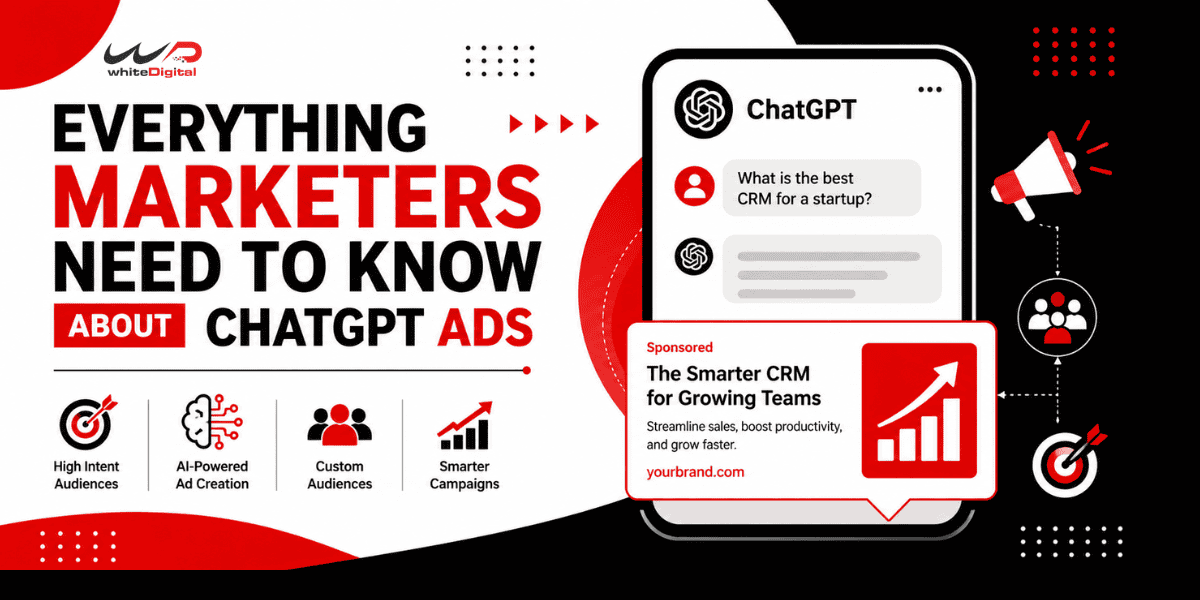
ChatGPT Ads: They are advertisements that show up in the ChatGPT experience as soon as they are relevant to the user’s conversation. Instead of disrupting the conversation, they appear at the bottom of the AI responses in a visually distinctive way from ChatGPT responses. Such ads hold the name of the advertiser or advertising agency, the brand’s logo, a headline with the description, an image and the URL to the landing page.
OpenAI clearly defines the difference between an ad and AI-generated responses. This makes it clear that the advertisers are not connected to the AI responses.
No conversation data is shared with advertisers and conversations regarding health, politics and any crisis are excluded from advertising. Currently, ads are shown only for eligible Free and Go users, while Plus, Pro, Business, Enterprise and Edu users don’t see any ads.
How Do ChatGPT Ads Work?
While Google Search Ads use the bidding process for keywords, ChatGPT Ads are based on the conversation’s intent.
If a person queries ChatGPT:
- “What is the best CRM for a start-up?”
- “Recommend running shoes worth ₹10,000.”
- “What is the best project management software?”
ChatGPT analyzes the conversation context to determine whether a sponsored advertisement can be beneficial to the user.
This approach allows advertisers to engage users who are in research, comparison and decision phases of the product purchase process. Unlike keyword match, ChatGPT takes into account the context of the conversation and ads might be more relevant than search ads.
Why should Marketers Care
Although ChatGPT Ads are a fairly new technology, marketers find them to have many benefits and some of them include,
Higher intent viewers
Many users come up with queries that are related to purchase, which is more valuable than the usual search.
Context-based ad targeting
All ads are based on what the users need and they don’t particularly target any specific keywords.
Create a campaign with the help of AI
Ads are created with the help of OpenAI, which reduces the work of humans, making it even easier.
Better user experience
There is always a gap between advertisers and the users that is separated by responses but with AI, it will let brands to reach out to their clients without breaking their trust.
Potential for future growth
With further adoption of ChatGPT, advertisers can secure their positions while competition is low.
Areas Where ChatGPT Ads Need Improvement
However, there is still room for improvement.
As compared to such well-established platforms as Google Ads, Meta Ads and Microsoft Advertising, advertisers currently have a limited number of available campaign types, targeting options, reports, attributions and automation capabilities.
Availability is still limited and there are many advanced optimizations yet to be offered. Industry analysts have also pointed out that advertisers need more measurement, inventory and controls over campaigns before allocating their budgets.
In any case, OpenAI is launching new functions almost weekly, which indicates rapid development of the platform.
Here are a few updates that will help you know better about the growth of ChatGPT Ads.
Update 1: AI Can Create Your ChatGPT Ads
One of the major updates is the possibility to create AI-generated ads in the ChatGPT Ads Manager.
No longer will marketers have to write each ad manually, because now they can simply choose the “Generate ads for you” option and ChatGPT will create ad drafts for them according to their campaign parameters. Advertisers can then look at these drafts, adjust them and confirm.
The benefits of this function include the following:
- Faster campaign creation.
- Assistance in overcoming writer’s block.
- Creating many ad versions for testing.
Making advertising simpler for small businesses that don’t have professional copywriters.
It does not replace the creative efforts of marketers, but rather acts as a template which the marketer can then tweak to suit his or her brand style and campaign needs. As AI-generated advertising becomes better, businesses will have more time to optimize their ads instead of spending it on their creation.
Update 2: New Overview Tab, Suggested Ad Drafts and New Ad Formats
OpenAI has made some updates to the Ads Manager as well to help with easier management of the ad campaigns.
Redesigned Overview tab
Now, advertisers will get an even better overview of their ad campaign performance as well as recommended optimizations and metrics via larger trend charts, thus not having to switch between multiple tabs to see how it all works.
Suggested ad drafts
Besides the creation of ads by artificial intelligence, the system also offers some new ad drafts which users can further customize without having to come up with something new each time.
New ad formats
Moreover, OpenAI has redesigned its ad cards as well as provided some extra creative formats for ads in ChatGPT.
Overall, all of these improvements help to decrease unnecessary efforts, facilitate the optimization process and make ChatGPT Ads Manager a more modern solution for the needs of advertisers. At the same time, OpenAI has also launched ChatGPT Ads in such countries as Japan and South Korea.
Update 3: Audience Lists Are Finally Coming Live
Among the most-demanded features by advertisers has been audience targeting customization, which is finally being launched by OpenAI.
The newly-launched Audience Lists feature gives advertisers the ability for advertisers to upload their customer data, such as raw/hashed email and phone numbers, to create their own custom audiences. This will allow them to either include or exclude certain users from campaigns, while being able to use bid multipliers at the ad group level for certain eligible audiences. At this point, there are recommendations to have at least 25,000 users in the audience list for its activation.
It will enable marketers to:
- Retarget existing customers.
- Exclude existing customers from acquisition campaigns.
- Target valuable customer segments.
- Make campaigns more relevant.
- Use more personalized advertising approaches.
Custom audiences have always been available on platforms like Google Ads and Meta Ads. Their presence in ChatGPT Ads means the platform is moving closer to offering marketers more options for targeting and managing their campaigns.
Implications of These Updates for Marketers
All in all, these updates indicate that OpenAI is no longer working with a simple advertising experiment but rather developing an advertising ecosystem.
With regard to AI-generated ads, the need for creativity is minimized, the Overview dashboard helps to make campaigns easier to manage and Audience Lists offer a much better approach to targeting. In other words, the latest improvements have made ChatGPT Ads a much more feasible choice for businesses interested in trying conversational ads.
Though currently lacking some of the advanced features provided by Google Ads and Meta Ads, it is quite evident from the speed of development of the platform that, soon enough, there will be fewer differences between them. For companies that are planning to try their hand at conversational advertising, it makes sense to start working on it now.
Coming to an end, ChatGPT Ads can be considered a revolutionary change in digital advertising, as now brands can target people not according to keyword research or demographics but through the means of conversations, revealing the real intentions of users.
It is obvious from the latest updates, such as the introduction of AI-generated ads, improvements in Ads Manager, the availability of refreshed ad formats and Audience Lists, that OpenAI is continuously improving the platform. Though still a young advertising ecosystem, its path is clear, make campaign creation easier, targeting smarter and advertising more user-focused.
For marketers, it is high time to familiarize themselves with the platform and use its features.