
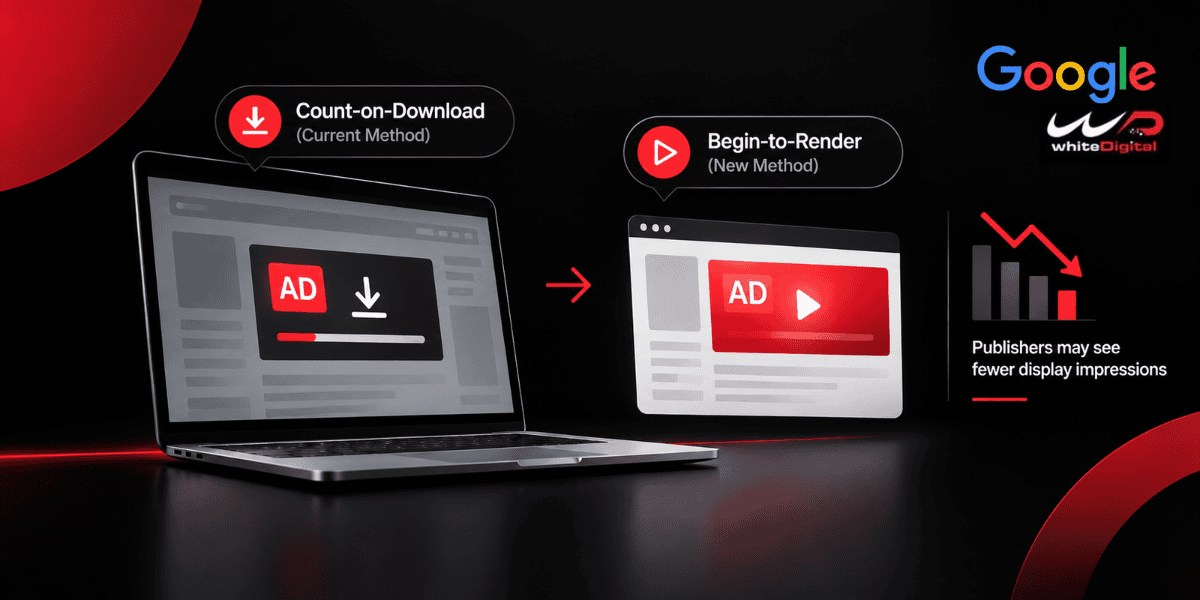
From the 17th of Feb, 2027, the display banner from the Google Ads and Google AdSense Inventory that is currently under the count on download method will be shifted to begin-to-render method. Under this method the impression will be only counted only after the ad creative is being rendered and loaded of the viewer’s screen.
The screens include desktop web, mobile web, banners on the connected TV along with the web view.
Google says that this does not affect the publishers or reduce their revenue in any means but there will be lesser impressions that is viewable in the advertiser report.
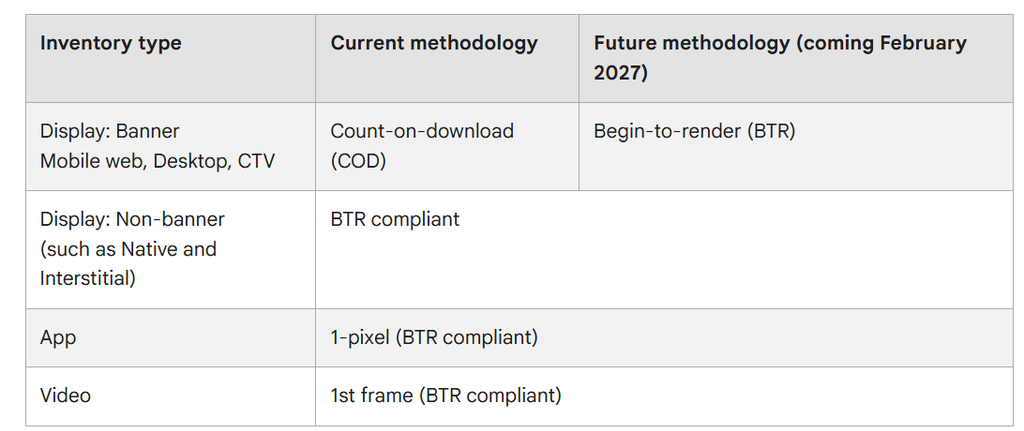
Source: Google
The most important part is this will change the point that Google now considers the ad impressions that has occurred.
Changes in the Google Ads Impression Metrics
Google is currently using the count on download method where the impression will be counted once the ad creative is being downloaded to the user’s device. But this method doesn’t require for the ad to appear on the screen and then the impression to be recorded.
The new update will change this. Google is about to use the begin-to-render (BTR) method. With the begin-to-render approach Google will hold the impression count until the ad creative is successfully loaded and rendered.
Let’s put in simple terms, the ad has to pass through the initial delivery process and that’s when it will qualify to appear in the impression count.
This is more concerned if the user leaves the page even before the ad starts to show up. There are many chances or technical issues that could prevent even before rendering the ads. The impression that was previously recorded with the count on download method will not be qualified under the begin-to-render method.
Why does publisher’s impression count go down?
The begin-to-render first shows its impact on the publisher reports. Let us explain with an example, a user opens the webpage and immediately an ad request will be sent and the ad creative begins it work by downloading but the user abandons the page even before the ad starts to render. This will be counted as impression under the current method but with the new one it won’t be added along with the impression count in the publisher report.
This will also imply to those ads that take longer to load or if it fails to render. The time gap between the start downloads and the render is the measurement gap.
Google has also informed that the publishers will be able to see the declined impressions. Google has not provided any information on the amount or percent of the decrease.
It is expected that this could be due to the different factors like user behaviour, the technology used, the ad delivery process and much more that will impact from rendering.
Publishers can be prepared for the impact
This update will be applicable from the start of Feb 2027 but the publishers don’t have to wait till then to experiment the changes. Google has provided the Google Ad manager for publishers with updated metrics, so that you can compare the current method and with the new one. This will help the publishers to understand the potential difference.
Google also recommends the publishers to use the report dated from the start of 12th of Aug 2026 for comparing the data.
This will help the them identify the potential gap and fill them before the update becomes a standard one.
What will affect the begin-to-render (BTR) performance?
The process of begin-to-render shows how important it is to reach the rendering stage and be counted as an impression.
Ad Creative Complexity
When there are too many assets in the ad it takes some time to load and while that happens there are many chances that the user might abandon the website. This will increase the time to render and even before that the user would have left.
Lazy rendering configuration
When it comes to ad creative being rendered, the website configuration also matters. When the settings are not in a way that renders easily, then it could affect the rendering speed. There are configuration that intentionally delays the speed of the ad loading speed which will result in not making it to the rendering threshold.
These are the factors publishers must keep an eye on beyond the impression count. This could be only sorted out by thoroughly examining the performance, getting inventory characteristics to fill the gaps and help in smooth rendering.
Why has Google come up with this update?
Google has mentioned that this update is to the display impression measurement near to the corresponding industrial standards and bring in techniques that boost demand side measurements.
Different set of techniques can bring a difference between the data by the publishers and the advertisers, platforms and third-party providers.
So, Google is about to bring in the begin-to-render feature to reduce the differences.
This will also filter out ad creatives that qualify as an impression. Instead of simply capturing the count of downloads this will bring the exact numbers that actually take it to the audience.
This will give a clear information for the advertisers on the impressions they have and the ones presented by the publishers.
What should the publishers do now?
As of now there is no big change rather than examining the impressions that actually render and make changes to the strategy accordingly. This is the period when you can and out what and how much you could have an impact. Like Google said, publishers can compare the data they have with the ones they had earlier dated up from 12th Aug, 2026.
Review the ad loading performance, check if the ad is more complex, synchronous scripts and lazy rendering configuration.
Coming to an end, this update may look like a slight change but it will have more impact on the number of impressions.
Publishers do not just prepare for the lower impression count but also to get to know why there is a fluctuation in numbers. There are yet a few more days to get ready to face the changes in your ad creatives and fill in the gaps and increase the impression count.