For a long time, keywords were the basis of Google Ads’ base strategy. Advertisers based their campaigns on the keywords they researched to find out what people were searching for and how to group them into similar ad groups.
To optimize their performance, they refined their keyword lists, adjusted their bids and added negative keywords to control the traffic generated by those keywords. While the above scenario still exists to some extent today, it no longer reflects how Google’s internal systems work.
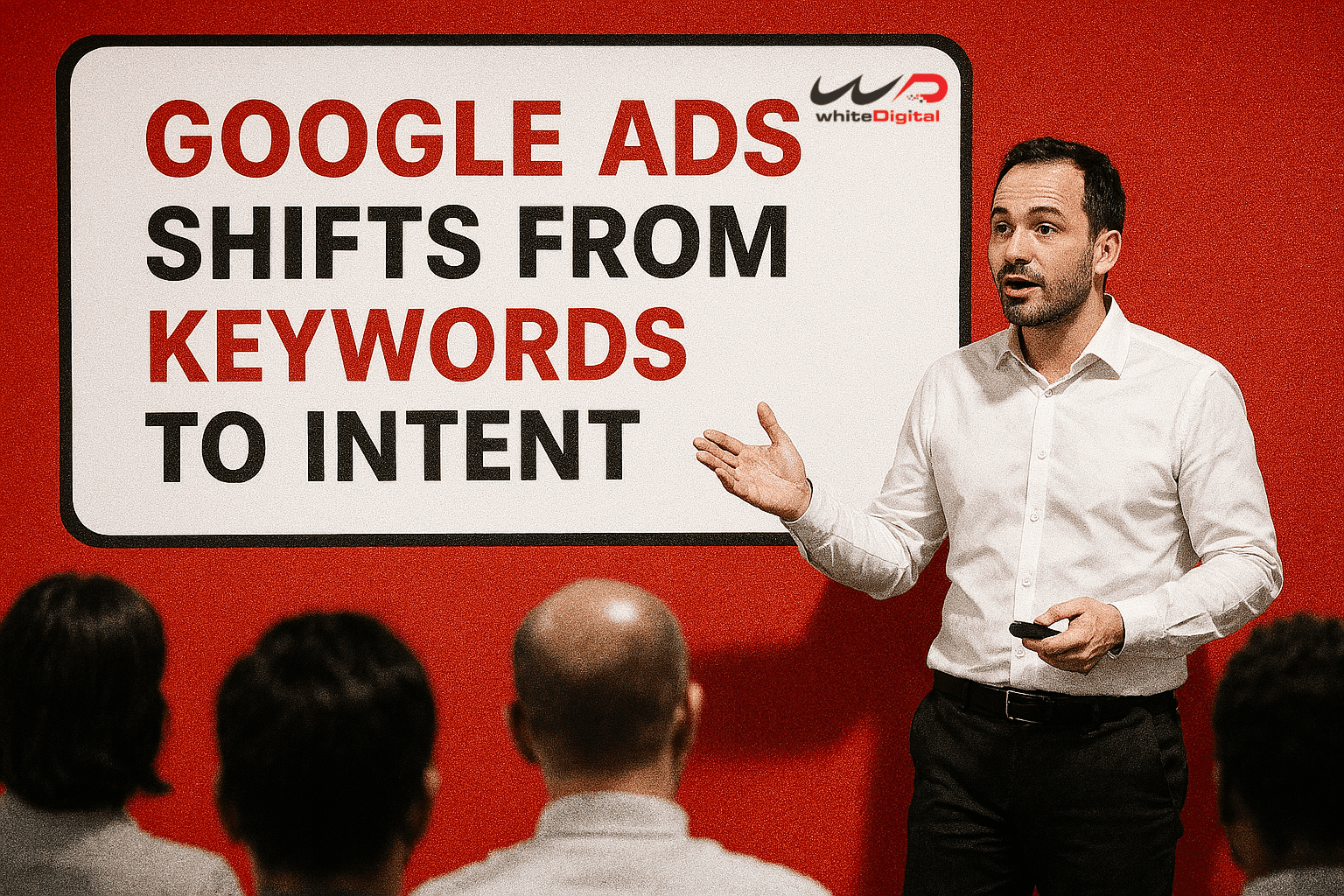
Today, Google Ads primarily runs on user intent. Rather than matching an exact word typed into the search box, their system uses all available signals to determine what a user is attempting to accomplish. The Google Ads auction is not triggered because a keyword matches a specific query, rather, it is triggered because Google’s internal models believe that the advertiser’s product or service meets the user’s overall goal.
How Google Determines the User’s Intent
User search behaviour is changing from only using single, literal queries as a basis for conducting a search. Users conduct searches that use complete sentences and contain complex, multi-part questions. Today’s users expect to receive contextual answers to their questions.
To anticipate user intent, Google uses various ways (search term meaning, historical behaviours, geolocation, device used and real-time context) to differentially assess a search term’s meaning. In fact, Google’s algorithms can often predict what the expected outcome and the user’s needs will be, even before a search is completed.
This means two users typing different queries may trigger the same ads if their intent is similar. Conversely, identical keywords may result in different ads if the inferred intent differs. Keywords now act as hints rather than strict triggers.
Why Match Types Matter Less Than Before
Previously, exact, phrase and broad match types had very different functions. This is no longer true due to the narrowing of these distinctions over time. Today, “exact match” does not guarantee you will receive only the terms you specified. Now, match type simply serves as guidance for how flexible Google can be when interpreting intention.
Using automated bidding in conjunction with a broad match type enables the system to explore intentional signals at scale. While both phrase and exact match types still provide some level of control, the way they limit query matching no longer applies as broadly as before. The items that matter most to the system are relevance and predicted performance, rather than a matching textual representation.
The Impact of AI and Automation
Automation is the force that underpins intent-based advertising. The use of Smart Bidding, responsive ads and dynamic asset combinations is all reliant on machine learning models that focus on probability, not certainty. The optimization of Google’s advertising efforts is based on achieving goals such as conversion, revenue, or engagement, not on achieving efficiency at the individual keyword level.
As a result, advertisers have to be more strategic with their advertising processes because they can now have a greater impact on their performance by focusing on such factors as conversion quality, audience signals, creative messaging and landing page relevance, as opposed to micromanaging keywords.
How the Auction Decides Which Ads Appear
The Google Ads auction process has changed from just comparing all the submitted bids to including keyword matching criteria. Now each auction considers several factors, including the intentions of the person searching, their predicted behaviour and context and evaluates all these factors in real time. Google can then predict the potential behaviour for a user and show an ad if it meets those criteria.
The main criteria for determining ad rank include the estimated click-through rate, quality of the landing page, creativity of the advertisement and the previous conversion rate based on the advertiser’s historical performance. Advertisers often will find that they receive many impressions or conversions from users that they did not specifically target. This is due to the inferred intent of the user.
What This Means for Advertisers
Implications for Advertisers
Campaigns are now less dependent on having perfect keyword coverage and more dependent on strategic alignment. Advertisers must clearly define their business objectives, supply accurate conversion metrics and ensure their messaging aligns with the user’s intent at different stages of the customer purchase journey. Weak or poor signals lead to incorrect automation decisions.
Negative keywords are still important. They provide restraining boundaries rather than driving controls. The three main levers of marketing include intent signals, value-based bids and creative that address customers’ needs as opposed to simply repeating keywords.
Optimizing Google Ads Strategy
To succeed in an intent-focused world, marketers should move past keywords. The campaign structure should be built to allow for learning instead of limitation. Fewer broad campaigns with robust data input are generally more successful than highly defined segments. Creative content should focus on problems, solutions and outcomes rather than just inserting appropriate keywords.
Advertisers must be confident in their choice of automation while still verifying their choices. Keeping track of search terms, quality of conversion data and performance trends is still extremely important. The change that has occurred is that marketing now occurs at the system level rather than at the keyword level.
Coming to an end, adherence to keywords alone does not guarantee success in Google Ads today. Rather, advertisers must have a keen understanding of what users are trying to accomplish, provide a clear signal of value and demonstrate how their campaign aligns with measurable company performance.
There is still something called keywords. However, intent is now what determines which ad gets displayed. As a result, capturing the business customers one seeks will be easier for those who embrace this change. Those who rely on outdated keyword methods will face significant disadvantages as the industry continues down this evolutionary path.