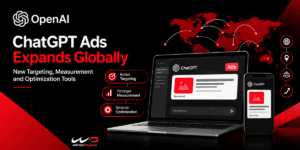

AI is revolutionizing the way people search, discover, and make decisions online. In fact, with ChatGPT ads starting to pop up directly inside AI conversations, we are entering a completely new era of digital marketing. These ads are different from traditional search campaigns or those on social media. Instead of being on a website or in a feed, they show up organically in the conversation providing relevant suggestions exactly when a user asks for help.
For agencies, this is more than an update; it’s the beginning of a whole new advertising channel that could redefine how brands get discovered.
A New Advertising Channel Is Born
ChatGPT ads are designed to blend seamlessly into conversations. They manifest themselves as subtle, context aware recommendations that go in flow with the question or intent that the user has. Unlike banner or display ads, they do not disrupt the experience at all. For agencies, this brings in a new service offering: Conversational AI campaign management. Early preparation of managing ChatGPT ads will help agencies position themselves for leadership in the next generation of digital marketing.
Why This Matters for Agencies?
For us as an agency, we have always adapted to shifts that happen in digital marketing from search ads and social campaigns to video ads, smart bidding, automation, and Pmax campaigns. Now, the shift is moving inside AI conversations, and ChatGPT ads are becoming a critical channel. Agencies that realize this early will be able to offer their clients a strategic advantage and capture opportunities that their competitors may miss.
1. Real-time delivery of high-intent leads
People don’t ask AI vague questions; they ask it exactly what they need. Searches like “best dentist near me,” “which flowers are good for weddings,” or “how do I fix my garage door” show strong intent. ChatGPT ads put businesses directly into these conversations at the moment users are ready to take action. This means higher visibility, more relevant engagement, and higher conversion rates than traditional search ads or social campaigns.
2. Better relevance = Better conversions
The conversational ads will appear only when AI is sure it has a helpful suggestion, meaning much less irrelevant traffic and cold audiences, and more users ready to decide. For service-based and niche-product businesses, the ads in ChatGPT might outperform traditional Google ads or social campaigns by offering a very efficient and predictable advertising solution.
3. Agencies can offer a new premium service
Clients will likely ask, “Can you manage my ChatGPT ads?” This opens up an opportunity for agencies to create a new offering to drive more revenue and also establish performance-based campaigns. Those that do start early will be able to deliver faster and take the lead in AI-driven advertising.
New Agency Roles That Will Soon Emerge
As this form of advertising continues to grow, agencies will want to add specialists who understand how AI interprets data, content, and user intent. Some roles that are likely to emerge include:
- AI Conversation Strategist
- Conversational Funnel Architect
- AI Content Optimization Specialist
- Recommendation Feed Manager
- Trust & Review Optimization Specialist
These roles will define the next era of digital marketing teams.
Why This Matters for Business?
ChatGPT ads may soon become one of the most powerful discovery channels for businesses. People want quick, direct answers and conversational AI delivers exactly that. Businesses that solve immediate problems stand to benefit the most because ChatGPT is excellent at understanding what a user needs in the moment and recommending a relevant solution instantly.
Industries That Should Prepare Immediately (Big Winners)
It makes some businesses inherently better positioned for success, as people generally search for them with a clear intent and urgency. These services have straightforward solutions, which makes it so much easier for ChatGPT to recommend the right business at the very moment their help is desired.
The industries most set to benefit from this advancement include:
- Dentists
- Florists
- Cleaning companies
- Handyman services
- Garage door repairs
- Local restaurants
- Tutors
- Fitness coaches
- Pet services
- Niche e-commerce stores
- Travel planners
- Interior designers
These businesses typically win when they appear at the moment of intent and conversational ads make that timing more precise than ever.
Industries That Should Be Cautious
Some sectors may experience slower impact. Many of these usually involve products or services requiring deeper research, longer decision cycles, or more detailed explanations than a short conversation can provide. Others may struggle if their website structure or messaging is unclear, making it harder for AI to understand what they offer.
The industries that would have to be most careful around ads with ChatGPT might include:
- Luxury brands
- Complicated B2B solutions
- High-ticket services with long funnels
- Businesses with unclear or confusing websites
- Brands with inconsistent pricing or messaging
For these businesses, simplifying messaging and improving clarity will be essential before AI can confidently recommend them.
Agencies Should Start Preparing Now
Success with ChatGPT ads is going to heavily rely on a business’s data, content clarity, and systems. Agencies should start strengthening:
- CRM integrations
- Lead tracking accuracy
- First-party data strategy
The complete and well-structured the data, the better AI can suggest a business during the conversation.
Conclusion
ChatGPT ads are bringing in a smarter, more natural way for people to discover products and services. Instead of scrolling through search results or social feeds, users get recommendations straight inside conversations. For agencies, this is a new chance to link clients with high-intent users in a brand-new digital space. For businesses, it’s a chance at being discovered at that very moment when someone needs them. The future of advertising is conversational discovery. Agencies and businesses that prepare now for ChatGPT ads will be leading the industry in 2026 and beyond.