
Think about how most of us start shopping for a car. Nobody opens a manufacturer’s website and reads a specification sheet on day one. We type something general into Google, like “compact hybrid SUV” or “best family sedan”, and scroll.
Google has noticed that moment, and it’s building an ad format around it in Google search ads. It’s called automotive model feeds on search ads (also known as Vehicle Top Ads), and it’s currently in beta.
What You’d Actually See in Google Search Ads
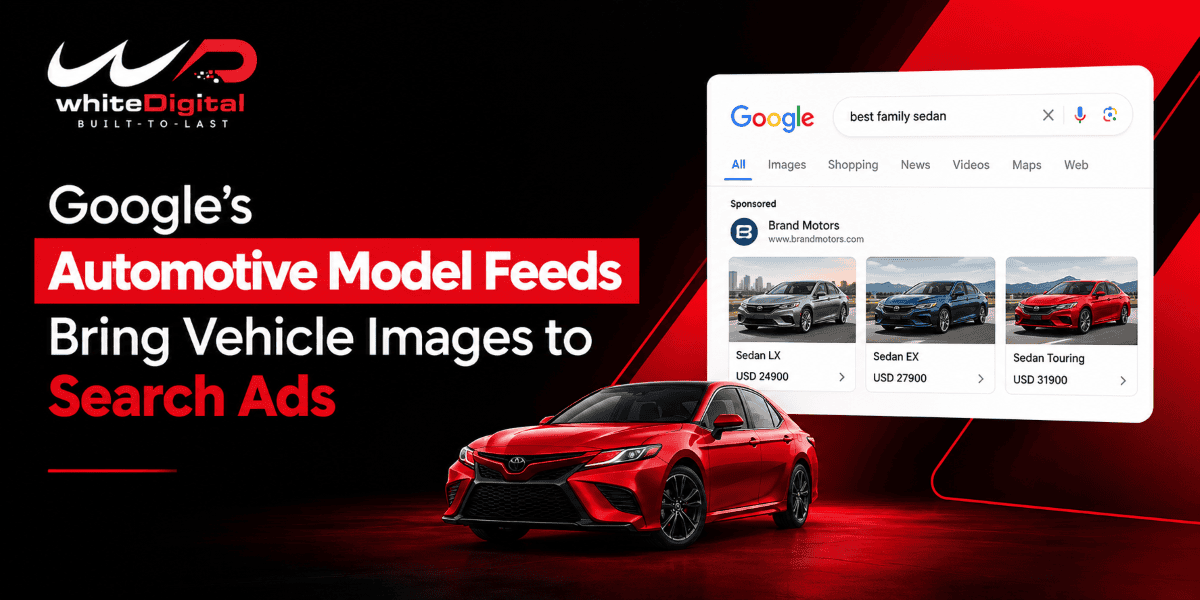
Rather than the text-only Google search ad, the headline of the brand receives a row of visual tiles below it. In mobile versions, there are two to five tiles, which feature the picture of the car, its model, trim, and price. By clicking a particular tile, the consumer gets redirected to either its respective model’s landing page or the Build & Price section.
This way, the brand gets a potential customer who already has some idea about the car design and its price range.
In this way, the consumer can browse before he or she clicks, and the company gets a visitor who is familiar with the model and price range of the automobile. It is a more productive click than a curious one.
Who Can Use Automotive Model Feeds on Google Search Ads
This is narrower than it sounds. It’s only for OEMs, meaning the Original Equipment Manufacturer. You need an active Search campaign, a valid feed, and you must be advertising in the US, Canada, Australia, or the UK.
The Part I like About Automotive Model Feeds
You don’t build new campaigns. You will upload one feed at the account level, via Business Data found in the Tools section. Matching will take place between the models in the feed and your current Search campaigns based on your text ads. If you use terms related to your models or categories in the headlines, such as “full-size SUV,” then the right tiles will appear. For campaigns built around one model, pinning a headline with the model name is worth considering.
Google Search Ads Automotive Model Feeds Requirements
Images have to be in a landscape ratio (1.78:1) and have minimum dimensions of 600 x 337 with recommended dimensions of 1200 x 675. There is no support for WebP files, and text should not be included on photos. Use USD and GBP instead of the $ and £ symbols when specifying prices.
Google recommends having at least three trims for each model, allowing for different titles and prices to be used across the tiles without repetitions. Additionally, the price you list in your feed has to coincide with that posted on your site. As prices are likely to be updated from time to time, scheduling upload of the new feed could be worthwhile.
Where the Click Takes You
Now the ad gives the shopper two choices, depending on what they want to see.
If someone taps a vehicle tile or image, they go straight to the Model Specification page or the Build & Price page on your website, whichever you set in your feed.
If they tap the main headline of the text ad, they go to the normal landing page set in the ad, just like with any other search ad.
My Take on Automotive Model Feeds in Google Search Ads
Most advertising changes ask you to learn something new. Brands that will benefit the most from this evolution will not necessarily have the largest budget; they will have the cleanest feed, transparent pricing, and photos and ad copy that include the model numbers.
This is also an opportunity to note that search advertising is moving away from text and toward the image of the product itself. If you work with automotive PPC, you should talk to your Google representative about it now.