
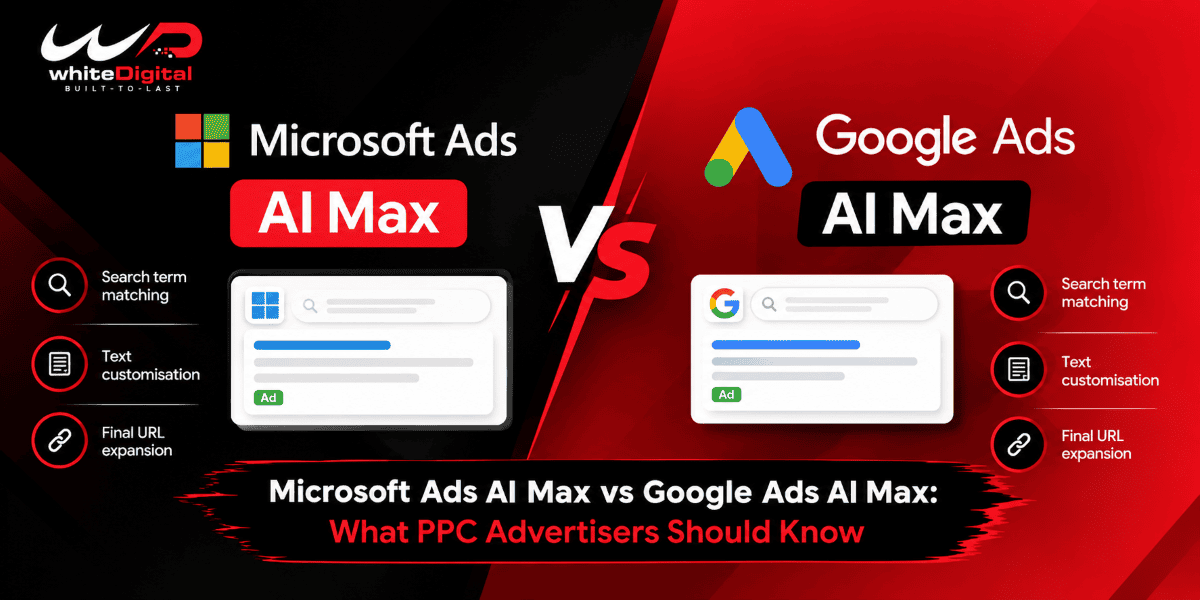
AI has changed how search campaigns are managed, from matching ads to relevant search queries to crafting ad copy and choosing landing pages. Both Google Ads and Microsoft Ads platforms are using AI Max in their search campaigns, although the two are not the same.
In August 2026, Microsoft Ads introduced AI Max for search campaigns that include search term matching, text customization, and final URL expansion to its search campaigns. Google Ads has also been using AI Max to help advertisers target their audience beyond their keyword targeting.
What is Google Ads AI Max?
Google Ads AI Max is comprised of several AI features meant to help advertisers improve the effectiveness of their search Campaigns by allowing them to expand beyond their existing keyword targeting and prepare the ad text according to the user’s search intention.
Key Features Include:
• Search term Matching: AI helps match ads with relevant search queries beyond an advertiser’s existing keyword list.
• Text customization: Google uses AI to generate or adapt ad headlines and descriptions based on the user’s search intent and website content.
• Final URL expansion: In case of final URL expansion, the user will be automatically redirected to the relevant page on the website based on their search query and intent, and not only to the landing page that was originally specified.
Advertisers can use these tools to identify new ways of searching without creating extra keyword lists and ads for each query. However, it totally depends on the quality of the website, conversion tracking, and campaign setup.
What is Microsoft Ads AI Max?
Microsoft Ads AI Max helps to grow and optimize search campaigns. It was rolled out in August 2026, and it comes with several functions such as automatic search term matching, text customization, and final URL expansion in Microsoft Advertising.
Just like Google, the goal of Microsoft Advertising AI Max is the same in that it seeks to figure out the intent behind the searches made and then changes itself to serve up the right content.
Key Features Include:
Automatic search term matching: AI helps show ads for relevant searches, even if the advertiser hasn’t added those search terms to the campaign manually.
Text customization: The text of the headline and description will be customized to suit the search and website content.
Final URL expansion: It redirects traffic to the relevant page depending on the search query.
Some manual work required for conducting search and ad creation will be minimized with the help of AI Max for campaign optimization.
Advertisers who already have ads on Microsoft Advertising may rely on AI Max to extend their search presence. The actual features, requirements, and controls offered have to be compared with up-to-date Microsoft Advertising guidelines.
The main difference between these two platforms is the advertising ecosystem, where each one has its own search audience, campaign management features, and reporting system.
Which AI Max Platform Should PPC Advertisers Choose?
The right platform will depend on the place where its customers search, the performance of its campaigns, the budget, and the business’s conversion data.
It might be worth considering Google Ads AI Max when:
- Google Ads is already generating quality leads or sales.
- When one wants to expand the keyword coverage beyond what it currently does.
- Landing pages are available and are able to track conversions in a reliable manner.
On the other hand, Microsoft Advertising AI Max can be considered when:
- Microsoft Advertising is already being used as part of the PPC strategy.
- A business that would like to explore additional search opportunities that Microsoft Advertising offers through its audience and distribution ecosystem.
- • Campaign data indicates that Microsoft Advertising can generate cost-effective, qualified conversions.
There is no need for businesses to depend on only one platform. It is important to monitor the performance across Google Ads and Microsoft Advertising, and it is best to split the budget based on their performance rather than evenly splitting the budget.
What PPC Advertisers Should Check Before Enabling AI Max
Before using them, advertisers should review their campaigns and establish a baseline to compare the performance of AI Max.
Conversion tracking: Make sure that leads, purchases, calls, and other important events are properly tracked.
Search relevance: Keep an eye on search terms and spot irrelevant traffic.
Landing page quality: Ensure that the landing pages that are available for expansion are relevant, accurate, and aimed at achieving conversions.
Performance reporting: When it comes to budgeting and bidding, make sure that the campaign’s budget and bidding strategies are in line with the business goals.
When reporting on performance, compare the cost per conversion, the conversion rate, lead quality, and revenue. Advertisers should examine the changes and compare the results with an appropriate baseline when carrying out tests.
Final Thoughts
Microsoft Ads AI Max and Google Ads AI Max belong to the trend of utilizing AI for search campaign management. Both of these tools help to extend search matching, ad personalization, and matching the user with a relevant landing page. However, for PPC Advertisers, it is necessary to consider the effects of such features on the process of campaign management, traffic quality, and conversion rate.
Although AI can automate some processes and introduce innovations into your marketing campaign, you still need to monitor its performance, manage the budget, and track results. The strongest approach is to test AI-powered features with clear objectives, monitor the quality of the traffic they generate, and scale them only when the results support business goals.