
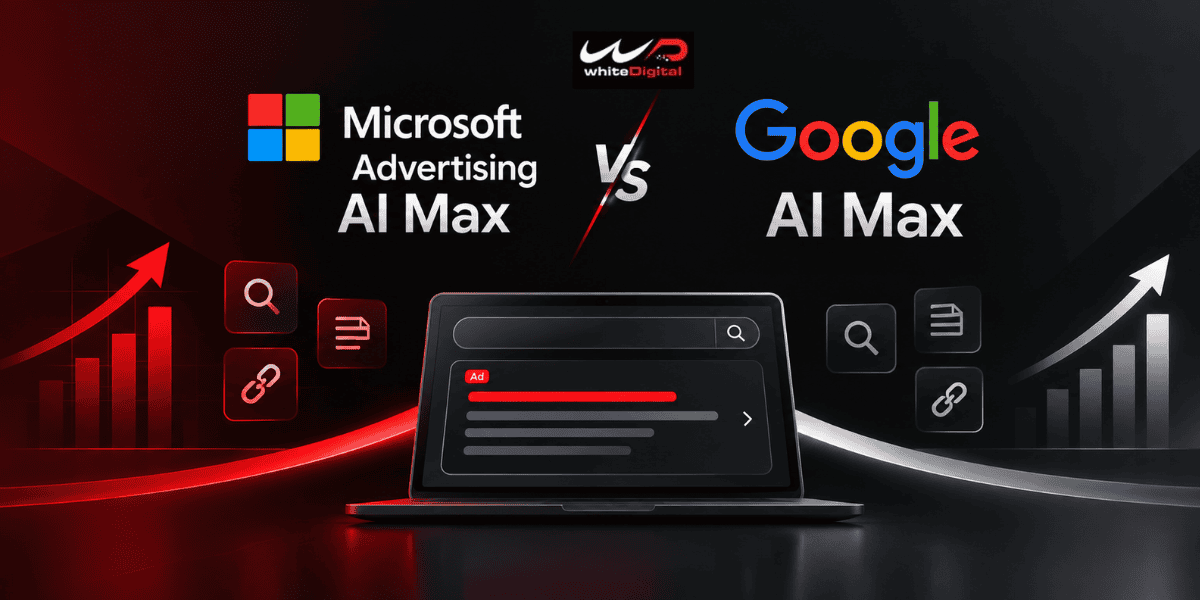
Microsoft Advertising is positioning itself more aggressively towards automated search advertising through its new set of features called AI Max, aimed at increasing the reach of keywords, creating ad copy based on these keywords, and sending visitors to more appropriate landing pages.
The launch of AI Max makes Microsoft more competitive with Google’s own AI Max offering for Search campaigns. But the more relevant question for advertisers isn’t whose AI offering is larger but who can give advertisers an edge without compromising efficiency and control.
The early results from campaigns that used AI Max show some good indicators. Advertisers have to figure out what these numbers really mean before acting on them.
What Is Microsoft Advertising AI Max?
Microsoft Advertising AI Max is a suite of AI-based functionalities offered for standard search campaigns, optionally. These include three functionalities to help advertisers reach relevant audiences in addition to their existing keyword lists.
Search term matching
Makes use of keywords, ad copy, landing pages, and context information to discover additional search terms that are relevant to the advertisers ads, including those that may be conversational and longer in nature.
Text generation
Creates additional ad copy through the use of creative elements and website content.
Final URL expansion
Guides the user traffic from the ads towards relevant pages on the advertiser’s website rather than a set landing page each time.
All these functionalities come together to achieve greater synchronization between search intent, ad message, and landing-page content. Microsoft also offers reporting for optimized search terms by AI, assets created, and landing-page destinations.
The system includes the existing campaign management functionalities, such as budgets, bid strategies, conversion goals, negative keywords, and targeting settings. Advertisers can also employ brand inclusions and exclusions in their campaigns.
What Are the Results of the Early AI Max Experiments?
The announcement by Microsoft on August 27 included information on performance statistics of early advertiser experiments. As per Microsoft, an analysis of 44 A/B experiments made by advertisers and carried out from June to August 2026 shows that there is a 13.6% spend-weighted conversion uplift in search campaigns that use AI Max compared with control campaigns in which the tool is turned off.
In addition, according to Microsoft, ten of these experiments have shown statistically significant positive results regarding conversions or conversion value with a lower confidence interval of 8.2%.
Thus, AI Max seems to be able to enhance the performance of search campaigns for some advertisers. Still, it should be approached critically.
Firstly, this information comes from the analysis made by Microsoft and not from industry-wide research performed independently. Secondly, the spending-weighted average does not imply that all advertisers got the 13.6% boost.
Reading about the distinction between conversion and conversion value is also important since creating more sales and leads does not necessarily imply better profitability if the effort is more costly.
Microsoft AI Max vs Google AI Max: What Is Different?
Both platforms use AI to optimize matching of search queries, tailor advertising messages, and increase the relevance of the query and the landing page. Their ultimate goals are similar, but advertisers should look at features and results rather than just the product names.
The AI Max for search campaigns of Google has also shown good performance. According to Google, there is an average uplift of 7% in conversions and conversion value at a similar cost per acquisition or return on ad spend by advertisers who utilize the full feature set as compared to search term matching.
Microsoft’s 13.6% uplift in conversions and Google’s 7% uplift in conversions have been derived through different experiments. Microsoft has performed an experiment in which campaigns that utilized AI Max were compared against those that did not use AI Max, whereas Google has done a comparison against the full feature set and search term matching only.
Hence, these figures cannot prove the superiority of Microsoft’s AI Max over Google’s offering since their control groups and experimentation settings are different. Advertisers need to perform tests themselves in order to make a proper comparison.
How AI Max Could Change Search Campaign Management
The most significant potential value from the use of Microsoft’s AI Max could be in its capability to determine search terms for which the advertisers have not made provisions.
For instance, an advertiser in the industrial machinery industry could be targeting the keyword phrase “industrial water pumps.” The use of AI could help them reach customers who were searching for different configurations in these pumps that the advertisers had not considered in their current list.
Text personalization could ensure that the messaging to the customer was tailored to their needs while URL expansion could direct them to pages that could match their requirements.
It would help save time in building a list of keywords or in creating different ads for each possible term. Nonetheless, the use of automated technology could also bring with it some dangers.
The interpretation of intent could go wrong, the messaging could be inconsistent with the brand image, and the page reached by the user could be relevant in the literal sense but wrong for the purpose of conversion.
Advertisers must check the search term report, examine the created content, verify the landing page, and also exclude unnecessary terms.
Steps to Measure AI Max Performance
It is just one step in the process to turn on AI Max. One needs to measure the performance of Microsoft Advertising campaigns with it compared to traditional marketing campaigns.
Firstly, one should gather information about how their campaigns currently perform, such as CPA, conversion value, ROAS, and conversion volume.
Secondly, one should conduct an experiment whenever possible and compare AI Max campaigns to a control group where bidding strategies, budgets, and conversion goals are kept constant to exclude any external factors.
One should evaluate the results not based on the volume of conversions only. If the campaign is for generating leads, one should measure qualified leads and closed deals. In the case of e-commerce businesses, one should measure revenue, average order value, and profit margins to see whether the conversions bring growth to the business.
Finally, one should check search term reports, automatically generated ad copies, and landing page destinations. These actions might show whether there are irrelevant keywords, inconsistent messaging, or even landing pages that drive traffic but do not result in conversions.
The Broader Context of AI-Powered Search Advertising
The Microsoft Advertising AI Max falls under a broader phenomenon in paid search advertising in which the efficiency of the whole campaign depends on the efficiency of artificial intelligence in interpreting the intent in the searches, creatives, and website content.
From the advertiser’s perspective, it offers a chance of creating demand beyond the keyword-targeting approach alone. It also calls for careful observation because of the possibility of automated expansion of keywords leading to increased traffic without improved business results.
While the early success by Microsoft is promising, more important will be their ability to achieve the same success in different industries and campaigns.
Coming to an end, rather than replacing the existing approaches with the AI Max approach, marketers need to think about adopting AI Max as an approach that can be tested. The winning platform in the end will be the one that can produce extra profit and enough transparency to manage its performance.