
When I run Meta Ads campaigns, I want my ads to reach people who are actually interested in what I offer. Showing an ad to everyone and hoping someone clicks is not much of a strategy. It is more like handing out flyers in a crowded street and hoping the right person picks one up!
This is where Meta’s Generative Ads Recommendation Model (GEM) comes into the picture. Meta shared an update about GEM on October 13, 2026. The update explained how its latest AI model is designed to improve ad recommendations across Facebook, Instagram, Reels, and other Meta advertising surfaces.
For advertisers, this update is worth paying attention to. The update focuses on how Meta’s AI understands user behavior. It also looks at how the AI decides which ads are more relevant to people.
GEM in Meta Ads
GEM stands for Generative Ads Recommendation Model. It is an AI foundation model. This model supports Meta’s advertising recommendation systems.
In terms GEM helps Meta understand patterns. These patterns are about how people interact with content and ads. It learns from signals such as clicks and conversions. This helps the platform predict which ads may be relevant to users.
Meta’s latest update describes a move towards an unified model. This model learns across advertising surfaces. It does this of relying entirely on separate systems for each area.
For instance, imagine a business selling running shoes. One person watches running videos. Another person visits fitness-related content. Someone else often interacts with sports products. These actions can give clues about what they might be interested in.
GEM helps Meta’s advertising systems recognize patterns across its platforms. This allows the system to predict which ads are more likely to get a response from people.
How GEM Can Help Meta Ads Campaigns
1. Better Ad Recommendations for the Right Audience
Audience targeting is a major part of Meta Ads. But reaching people who match a broad interest category does not automatically mean they are ready to engage or purchase.
GEM helps improve the recommendation systems that determine which ads are shown to which people. Its ability to learn from behavior across Meta’s advertising surfaces can help the platform recognize patterns. These patterns might otherwise be missed.
For example, a home renovation company may want to reach people in kitchen upgrades. Two people might both interact with home improvement content. Their behavior may show different interests. It may also show levels of purchase intent.
Meta’s AI can use signals to make predictions about ad relevance.
For advertisers, the goal is to connect with people who are more likely to find the offer useful. That does not remove the need for good audience research, but it can support the platform’s delivery decisions.
2. More Opportunities to Improve Clicks and Conversions
Clicks are useful. If an ad gets plenty of clicks without generating enquiries or sales, there is still a problem to solve.
Meta says its latest GEM generation has delivered an 18.9% improvement in conversions and a 12% improvement in ad click-through rate (CTR) across Facebook advertising surfaces and objectives.
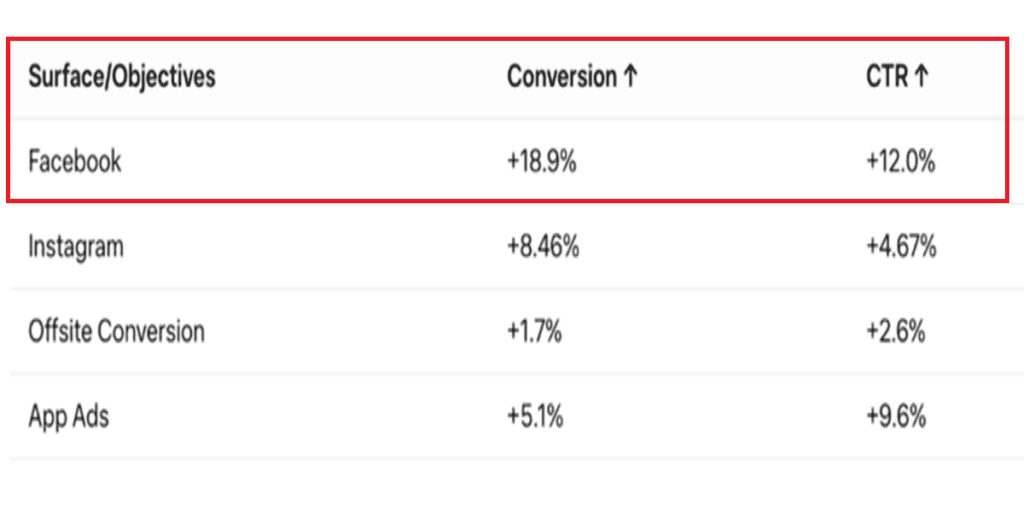
For advertisers, this matters because a person clicking an ad and a person completing a purchase are two different outcomes. Better recommendation models can help Meta make more informed predictions across different stages of the customer journey.
Still, a smart recommendation system cannot rescue every campaign. If the offer is confusing, the creative is weak, or the landing page takes forever to load, even a promising ad can struggle.
3. More Consistent Learning Across Facebook and Instagram
Many businesses advertise across multiple Meta placements, including Facebook Feed, Instagram Feed, Stories, and Reels.
Previously, different surfaces and advertising objectives relied on their own prediction systems. Meta’s latest GEM update describes a more unified approach that learns across surfaces and objectives.
Why does that matter?
Imagine an online clothing store running campaigns across Facebook and Instagram. People might discover a product in a Reel, click an ad in their Feed, or eventually purchase after seeing another placement.
A system that learns across different surfaces can use broader patterns to improve its predictions. GEM is designed to support this kind of cross-surface learning while helping Meta optimise for objectives ranging from clicks to conversions.
This does not mean every placement will perform equally well. A creative that works in Reels may still need a different format for Feed. Advertisers should continue checking placement-level results instead of assuming one ad will work everywhere.
4. Better Support for Different Campaign Goals
Each Meta Ads campaign has its own goals. One business may want more website visits, and another may focus on purchases or lead generation.
Meta says GEM’s latest generation jointly supports click and conversion predictions across multiple advertising surfaces and objectives.
This can help Meta’s recommendation systems learn from broader engagement patterns and apply that knowledge to different campaign goals.
For example, a business running lead generation campaigns needs more than people who enjoy watching its videos. It wants people who may actually complete a lead form or contact the business.
GEM supports the AI systems making those predictions, but advertisers still need to choose suitable campaign objectives and measure the actions that matter to their business.
Does GEM Mean Advertisers Need to Change Their Meta Ads Strategy?
Not necessarily. GEM is an underlying AI model, not a new setting that advertisers can switch on in Ads Manager.
You do not need to find a GEM button, enable a special campaign option, or rebuild every campaign because of this announcement.
Instead, I would treat this update as a reason to keep the basics strong while Meta continues improving its advertising AI.
- Make relevant ads: Use messages and images that fit with what the audience is searching for.
- Check conversion tracking: Ensure leads, purchases, and other important actions are tracked properly.
- Test your creatives: See how messages and formats perform.
- Check campaign performance: Don’t just look at clicks and impressions. Check conversions and cost per result. Return on ad spend when it matters.
- Improve landing pages: Give visitors a next step once they click your ad.
AI can help Meta make better delivery predictions, but advertisers still need to give the system a clear objective, useful creative, and reliable measurement.
Final Thoughts
Meta’s GEM update shows how the platform is developing its AI to make advertising recommendations across Facebook, Instagram, and other surfaces more effective.
For advertisers, the potential benefit is better matching between ads and the people who may be interested in them and how AI influences campaign delivery and performance.
But I still believe the basics matter. Good creative, a relevant offer, accurate conversion tracking, and a useful landing page remain important parts of a successful campaign.
Want to turn smarter Meta Ads strategies into better campaign results? Contact us to explore how we can help you build, track, and optimize campaigns that connect with the right audience.